Best Advanced Code Security Tools in 2026

TL;DR overview
- Advanced code security tools protect software by integrating multi-layered SAST, SCA, and runtime analysis into modern workflows.
- Unlike basic vulnerability scanning, advanced security solutions provide contextual, risk-based prioritization directly within CI/CD pipelines.
- Platforms like SonarQube evolve quality metrics into an application security platform supporting over 35 programming languages.
- These systems reinforce secure coding practices and refactoring to remediate cloud-native software risks without slowing innovation.
Why Advanced Code Security is Important in 2026
In 2026, software is built and deployed faster than ever, driven by cloud-native architectures, AI-assisted development, and complex open-source ecosystems. This speed increases the attack surface across source code, dependencies, APIs, and runtime environments, making traditional security approaches insufficient. Modern applications rely heavily on third-party libraries, microservices, and continuous delivery pipelines, which means a single vulnerable component or misconfiguration can cascade into large-scale breaches. Advanced code security tools—combining static analysis, software composition analysis, and runtime-aware testing—are essential to detect vulnerabilities early, reduce exposure, and ensure secure coding practices are enforced consistently throughout the software development lifecycle.
At the same time, regulatory pressure and real-world exploitation demand better prioritization and developer alignment. Security teams can no longer afford overwhelming backlogs of low-value findings; they need contextual, risk-based insights that highlight what is actually exploitable and impactful. Advanced code security solutions help bridge the gap between developers and security by integrating directly into IDEs and CI/CD pipelines, providing actionable guidance, and supporting secure code refactoring before issues reach production. In 2026, effective code security is not just about finding flaws—it’s about enabling teams to deliver high-quality, secure software at scale without slowing innovation.
What is Advanced Security?
Advanced security refers to a modern, integrated approach to protecting software applications that goes beyond basic vulnerability scanning. Instead of relying on a single technique, advanced security combines multiple layers of analysis—such as static application security testing (SAST), software composition analysis (SCA), dynamic and interactive testing, and runtime context—to identify weaknesses across the entire software supply chain. This approach focuses not only on detecting known vulnerability patterns, but also on understanding data flows, configuration risks, insecure coding practices, and the real-world impact of issues within cloud-native and distributed architectures.
Crucially, advanced security emphasizes context, automation, and developer enablement. Modern solutions integrate directly into IDEs, CI/CD pipelines, and cloud environments, providing fast feedback and clear remediation guidance where developers work. By correlating code-level findings with dependency risk, exposure, and exploitability, advanced security helps teams prioritize the vulnerabilities that matter most. In 2026, advanced security is about embedding security into everyday development workflows—making secure coding, code refactoring, and continuous risk reduction a natural part of building and maintaining software at scale.
Top Advanced Code Security Tools in 2026
In 2026, application security isn’t just an add-on — it’s a foundational part of software engineering. Teams must detect vulnerabilities early in the SDLC, manage open-source risk, and validate security in runtime environments. Advanced tools now combine static, dynamic, interactive, and composition analysis with contextual risk insights to help engineering teams build resilient, compliant systems — fast.
This guide highlights the leading code security tools available today, organized by capabilities and real-world use cases across development and operations.
1. SonarQube
SonarQube has grown from a core code-quality scanner into a full-featured application security platform that blends SAST and SCA with developer-centric workflows. It detects hundreds of security issue types — from injection flaws to secrets and infrastructure misconfigurations — before they hit production.
Key Features
- Advanced SAST Engine: Delivers comprehensive analysis across 35+ languages with rich rule sets and taint-based vulnerability detection.
- Software Composition Analysis (SCA): Identifies known CVEs in open-source dependencies, generates SBOMs, and enforces license policies.
- AI-Inspected Code Support: Evaluates generative AI output for security quality before merge, helping teams govern rapidly evolving codebases.
- Seamless DevOps Integration: Works inside IDEs, Git workflows, and CI/CD pipelines to catch issues early and block risky changes.
- Enterprise Governance & Trends: Dashboards and metrics help security leaders track risk posture and historical trends across projects.
Best for: Teams that want one platform that centralizes quality and security, with strong shift-left support.
Semgrep
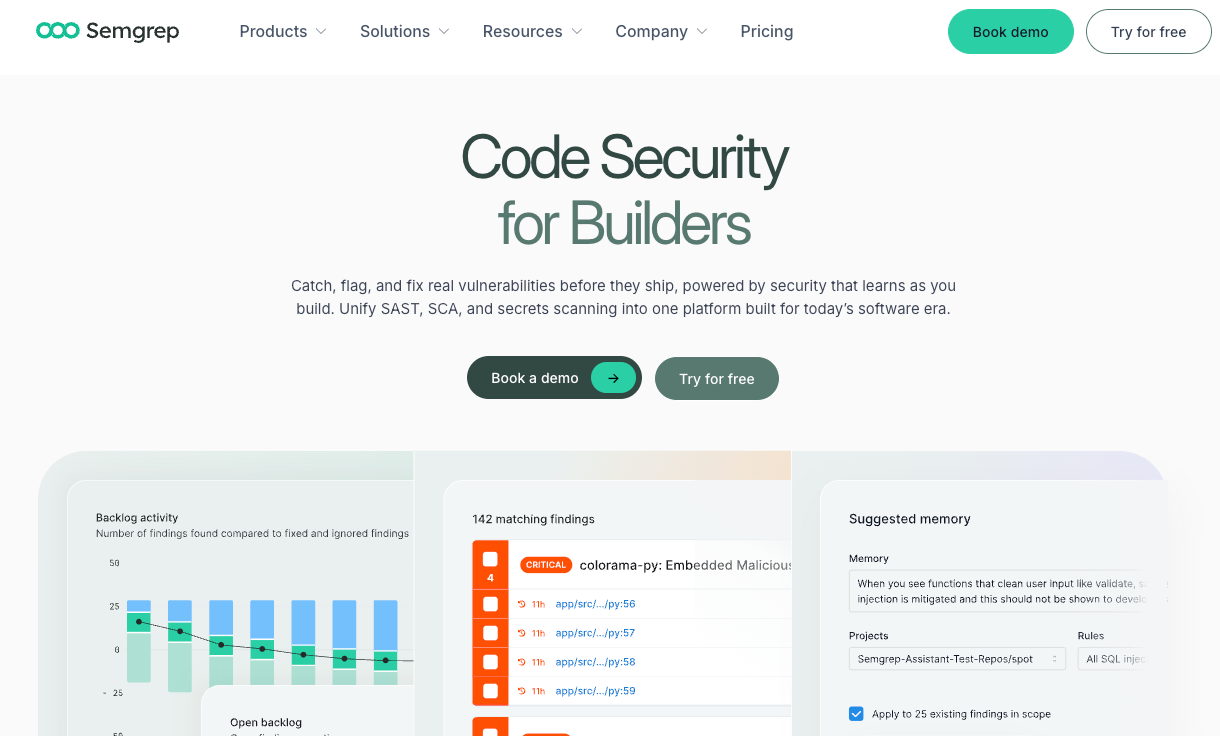
Semgrep is one of the most flexible SAST tools available: fast, customizable, and developer-friendly. It excels at detecting pattern-based vulnerabilities directly within pull requests and merge workflows.
Key Features
- Pattern-Driven Detection: Allows writing bespoke security and governance rules that govern your code style and security policies.
- Rapid Scanning: Designed to scan code quickly (pull request-level) so security checks don’t slow down CI/CD.
- Open Source + Commercial Rulesets: Access baseline rules for OWASP vulnerabilities, injection vectors, and logic flaws, while extending with custom policies.
- Developer First: Simple CLI and integrations with GitHub, GitLab, and CI tools encourage adoption across teams.
Best for: Organizations that want custom actionable rules and fast scans that fit seamlessly into merge workflows.
Black Duck / Mend.io
Managing third-party and open-source dependencies is critical — and tools like Black Duck and Mend now deliver deep SCA coverage with remediation guidance across languages and ecosystems.
Key Features
- Comprehensive Dependency Scanning: Detects CVEs, license risks, and outdated packages across open-source stacks.
- Automated Fix Suggestions: Provides actionable advice and alerting to patch vulnerable components.
- SBOM & Policy Enforcement: Helps teams generate software bills of materials and enforce internal compliance guardrails for regulated environments.
- Contextual Risk Prioritization: Advanced scoring tells you which vulnerabilities matter most to your runtime exposure.
Burp Suite
Burp Suite continues to be the gold standard for dynamic security testing. It performs runtime exploration with a human analyst in the loop — ideal for uncovering logic errors and business-critical flaws that static tools miss.
Key Features
- Interactive Scanning: Simulates real-world attack patterns against live applications.
- Proxy & Injection Tools: Intercepts traffic, tests inputs for SQLi/XSS, and probes sessions effectively.
- Extensible Platform: Large plugin ecosystem adds automation, reporting, and custom testing techniques.
Detectify / Acunetix
Detectify and Acunetix shift focus to external attack surface management (EASM) and automated dynamic scanning of web applications and APIs. These tools help teams discover exposed endpoints and security gaps in runtime environments.
Key Features
- Black-Box Scans: Evaluates apps live, without access to source code, to find exploitable weaknesses like XSS and authentication bypasses.
- API Security Testing: Identifies broken authorizations, schema issues, and misconfigured endpoints.
- Continuous Monitoring: Alerts on emerging exposures across internet-facing assets.
Choosing the Right Tool for Your Advanced Security
Choosing the right advanced code security tool in 2026 starts with understanding your development environment and risk profile. Different tools excel at different stages of the software development lifecycle, so the goal is rarely to find a single “silver bullet.” Teams should evaluate how well a solution supports shift-left security through SAST and SCA, integrates with existing IDEs and CI/CD pipelines, and scales across the languages, frameworks, and cloud platforms they use. Just as important is accuracy—tools that generate excessive false positives quickly lose developer trust and slow down delivery, while context-aware analysis helps teams focus on issues that truly affect application security.
Equally critical is how a tool fits into day-to-day workflows and long-term governance. The best advanced security solutions provide clear remediation guidance, support secure code refactoring, and align with industry standards such as OWASP and CWE without overwhelming teams. For larger organizations, visibility and reporting matter: dashboards, trends, and policy enforcement help security leaders track risk reduction over time and meet compliance requirements. Ultimately, the right tool is one that empowers developers and security teams to collaborate effectively—embedding security into development without sacrificing speed, quality, or innovation.
FAQs
1. What makes a code security tool “advanced” in 2026?
An advanced code security tool goes beyond basic vulnerability scanning by combining multiple analysis techniques such as SAST, software composition analysis (SCA), dynamic or interactive testing, and contextual risk prioritization. These tools integrate directly into IDEs and CI/CD pipelines, reduce false positives, and provide actionable remediation guidance. The focus is on understanding real-world risk, not just detecting isolated issues.
2. Do advanced code security tools replace manual security reviews and penetration testing?
No. Advanced security tools significantly reduce risk by catching vulnerabilities early and continuously, but they complement—not replace—manual reviews and penetration testing. Automated tools are excellent for scale and consistency, while human-driven testing is still valuable for uncovering complex business logic flaws and validating critical systems before release.
3. How do advanced security tools help developers, not just security teams?
Modern tools are designed with developers in mind. They surface issues directly in IDEs and pull requests, explain why a vulnerability matters, and suggest secure coding fixes. By providing fast feedback and supporting secure code refactoring, advanced security tools help developers fix problems early without slowing down development.
4. Are advanced code security tools suitable for small teams and startups?
Yes. Many advanced security solutions now offer lightweight setups, cloud-based deployment, and flexible pricing. Small teams benefit from early vulnerability detection, dependency risk visibility, and automated guardrails that prevent security debt from accumulating as applications scale.
5. How should teams measure the success of an advanced code security program?
Success should be measured by reduced security risk over time, not just the number of findings. Key indicators include fewer critical vulnerabilities reaching production, faster remediation times, improved developer adoption, and consistent enforcement of secure coding standards. Trend analysis and risk-based reporting are often more meaningful than raw vulnerability counts.
