Best AI Code Review Tools for Developers in 2026

TL;DR overview
- AI code review combines machine learning and static code analysis to automatically scan source code for defects, security vulnerabilities, and quality issues.
- This automated process accelerates software quality assurance by catching bugs early within IDEs and continuous integration pipelines.
- AI tools handle repetitive checks, allowing human reviewers to focus on complex architectural decisions and design patterns.
- Leading 2026 platforms like SonarQube, Greptile, and Zencoder optimize maintainability and readability while strengthening development team collaboration.
Why AI Code Review Is Important in 2026
In 2026, the scale, speed, and complexity of modern software development have made traditional code review practices alone insufficient. Teams are shipping more frequently, managing larger codebases, and supporting distributed systems where even small changes can introduce defects, performance problems, or security vulnerabilities. AI-powered static code analysis helps reviewers keep up by automatically scanning source code for correctness, readability, maintainability, and uniformity before human peer review even begins. By identifying issues early in the development process—often directly within pull requests or IDEs—AI reduces review bottlenecks and ensures higher overall software quality assurance.
Equally important, AI code review strengthens collaboration and shared ownership of code. Instead of replacing human reviewers, AI tools act as consistent, always-available assistants that enforce best coding practices, surface potential risks, and provide objective feedback across teams. This allows reviewers to focus on higher-level concerns such as design decisions, architectural trade-offs, and long-term maintainability. In an era where teams must balance speed with reliability, AI-assisted code review has become essential for delivering secure, high-quality software at scale.
What is AI Code Review?
AI code review is the use of artificial intelligence to automatically analyze source code and assist developers during the code review process. By combining machine learning with static code analysis, AI tools examine code changes, commits, and pull requests to detect defects, security vulnerabilities, performance issues, and violations of best coding practices. These tools operate continuously throughout the development process, providing fast, consistent feedback that complements traditional peer review by human reviewers.
Rather than replacing developers, AI code review enhances software quality assurance by handling repetitive and time-consuming checks at scale. It improves correctness, readability, maintainability, and uniformity across a codebase, while also supporting knowledge transfer and shared code ownership within teams. In modern workflows, AI code review is embedded into IDEs, CI/CD pipelines, and pull requests, enabling teams to catch issues early, reduce review friction, and deliver higher-quality software with greater confidence.
The Top 5 AI Code Review Tools in 2026
In 2026, the landscape of automated and AI-powered review tools continues to evolve. Leading platforms now combine static code analysis, intelligent code inspection, contextual insights, and IDE integrations, helping developers reduce technical debt and deliver more maintainable, secure software.
Below is our curated list of the best AI code review tools trending in 2026 — from industry stalwarts to cutting-edge AI assistants.
1. SonarQube — Comprehensive, AI-Enhanced Code Quality & Security

G2 Review: 4.4/5
Why It’s #1
SonarQube is the industry benchmark for automated code review and software quality assurance. Trusted by enterprises and open-source communities alike, it continuously inspects source code to detect bugs, security vulnerabilities, code smells, and maintainability issues long before they reach production.
Unlike tools that focus only on pull request feedback, SonarQube analyzes the entire codebase, ensuring long-term correctness, uniformity, and readability — not just short-term fixes.
Key Features
- Multi-language static code analysis (35+ languages)
- Security vulnerability detection and compliance reporting
- Quality gates enforcing standards on pull requests
- Maintainability and technical debt tracking
- IDE plugins and SonarQube Cloud for seamless integration
- Code duplication and complexity analysis
- Rich dashboards for team metrics and trends
With SonarQube Cloud enabling scalable cloud-native analysis and SonarQube for IDE providing immediate developer feedback, SonarQube supports every stage of the development process — from local coding to final review.
2. Gitar AI Code Review
Best For
Agentic AI code review and automated pull request remediation
Key Features
- AI-powered pull request reviews with full codebase context
- Automatic bug and logic error detection
- CI failure analysis and root-cause identification
- Auto-generated fixes validated against CI pipelines
- GitHub and GitLab integrations
- Custom review policies defined in natural language
- Self-hosted deployment options for enterprise security
Pros
- Fixes issues automatically instead of only reporting them
- Reviews code with awareness of broader codebase context
- Reduces manual code review and CI troubleshooting effort
- Strong support for AI-generated code validation
- Enterprise-friendly deployment options
Cons
- Newer platform compared to more established competitors
- Advanced automation capabilities may require workflow tuning
- Pricing details require direct consultation
Pricing Summary
Free trial available with custom team and enterprise pricing.
Ideal User
Engineering teams managing high pull request volume, AI-generated code, and complex CI/CD environments.
Why It Stands Out
Gitar goes beyond traditional AI code review by automatically diagnosing issues, generating fixes, validating them against CI pipelines, and applying changes directly to pull requests. Its combination of contextual code understanding, automated remediation, and CI-aware validation makes it one of the most advanced agentic code review platforms currently available.
3. Zencoder — Deep Contextual AI Reviews
G2 Review: 4.9/5
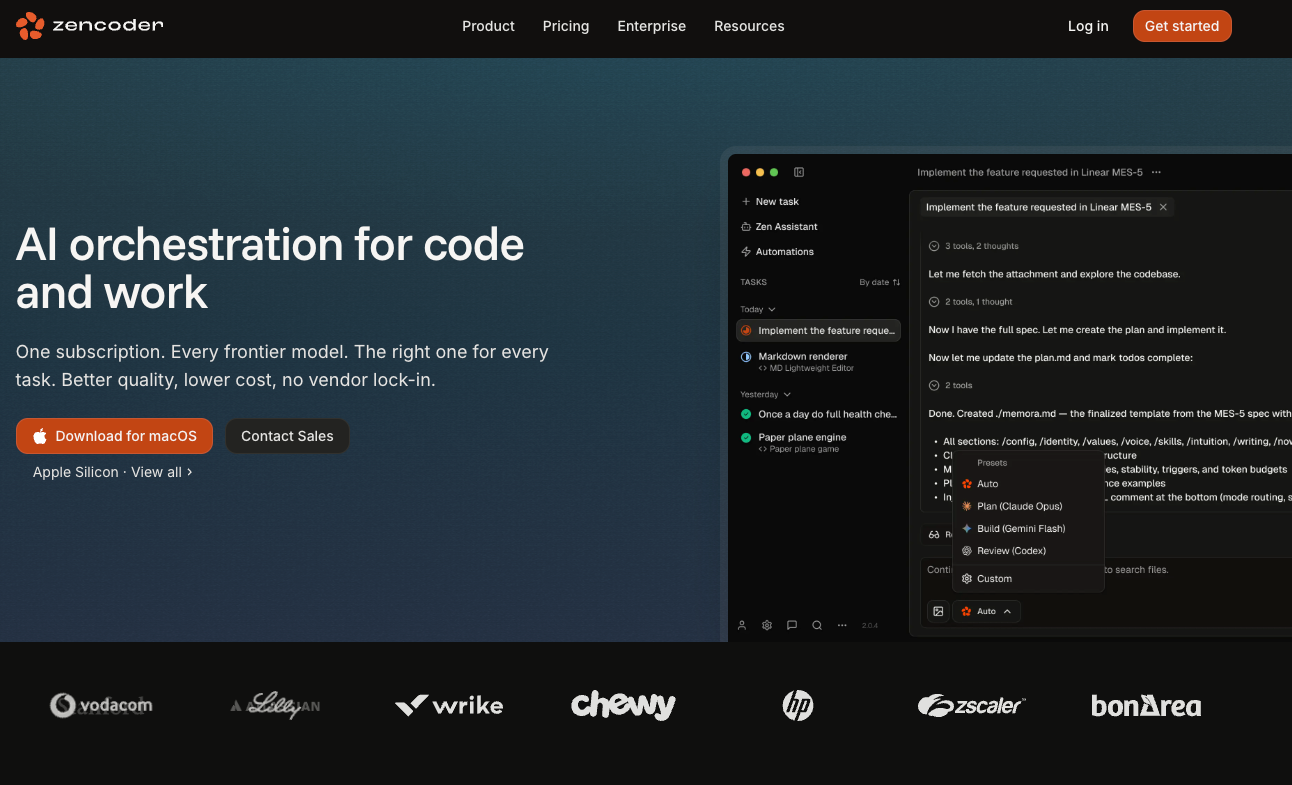
Zencoder applies context-aware AI to analyze full repositories, not just diffs. It specializes in deeper architectural and design insights during the review process.
Key Features
- System-wide codebase analysis
- Design and architecture quality feedback
- Technical debt patterns detection
- Customizable review rules
- Team dashboards and impact scoring
4. Codacy — Rules-Driven Code Quality Automation
G2 Review: 4.6/5
Codacy automates code review with customizable rulesets that enforce style, structure, and quality standards across repositories.
Key Features
- Custom static analysis rules
- Automated feedback on pull requests
- Multi-language support
- Quality metrics and historical trends
- Integrations with popular VCS and CI systems
5. Snyk Code — Security-First AI Code Review
G2 Review: 4.5/5
Security vulnerabilities often hide in subtle logic. Snyk Code uses AI to catch security issues early in the development process — complementing human reviewers.
Key Features
- Automated security vulnerability scanning
- Policy enforcement for DevSecOps
- Detailed remediation suggestions
- Contextual threat scoring
- Integration with CI/CD and IDEs
Choosing the Right Tool for AI Code Review
Selecting the right AI code review tool in 2026 depends on your team’s priorities, workflow, and long-term goals for software quality assurance. Start by evaluating the core capabilities you need: do you want deep static code analysis across an entire codebase, focused security vulnerability detection, or light-weight assistance embedded directly into pull requests and IDEs? Tools like SonarQube excel at comprehensive quality and maintainability insights, while others such as Snyk Code focus more on security, and GitHub Copilot emphasizes real-time feedback during everyday development. Understanding where your biggest pain points are—be it catching bugs earlier, enforcing uniform coding standards, or reducing the workload on human reviewers—will guide you toward tools that align with your team’s goals.
Equally important is how well a tool integrates into your existing development process and infrastructure. Look for platforms that seamlessly support your version control system, integrate with your CI/CD pipeline, and provide actionable feedback within pull requests, so reviewers and authors can quickly iterate on changes. Consider also the balance between automation and human judgment: while AI can flag potential issues and enforce metrics like maintainability and readability, human reviewers remain essential for assessing architectural decisions, nuanced logic, and team-specific design patterns. By weighing capability, integration, and team workflows, you can choose an AI code review tool that enhances productivity while strengthening code quality and collaboration.
FAQs
1. What is the difference between AI code review and traditional peer review?
Traditional peer review relies on human reviewers to manually inspect source code for defects, readability, and design issues. AI code review augments this process by using static code analysis and machine learning to automatically detect bugs, security vulnerabilities, and maintainability issues at scale. AI handles repetitive and rule-based checks, allowing human reviewers to focus on higher-level architecture and logic.
2. Can AI code review replace human reviewers?
No. AI code review is designed to support, not replace, human reviewers. While AI excels at consistency, speed, and identifying common defects, human judgment is still essential for understanding business logic, architectural trade-offs, and context-specific decisions. The most effective teams combine AI-powered automation with expert peer review.
3. How does AI code review improve software quality assurance?
AI code review improves software quality assurance by continuously analyzing code throughout the development process. It catches defects, performance problems, and security vulnerabilities early—often before code is merged—helping teams maintain high standards for correctness, uniformity, and long-term maintainability.
4. Does AI code review slow down development?
On the contrary, AI code review typically accelerates development. By providing immediate feedback in IDEs and pull requests, AI reduces review cycles, minimizes back-and-forth between authors and reviewers, and prevents costly rework later. This leads to faster merges and more predictable delivery timelines.
5. What should teams look for when choosing an AI code review tool?
Teams should consider the depth of static code analysis, support for required programming languages, security coverage, integration with CI/CD and pull requests, and reporting capabilities. It’s also important to choose a tool that fits existing workflows and complements human peer review rather than overwhelming developers with noise.
