Best C Static Code Analysis Tools in 2026

TL;DR overview
- C static code analysis is the automated examination of C source code without execution to identify defects, vulnerabilities, and maintainability issues early in development.
- Integrating these tools into workflows helps catch severe risks like buffer overflows and null-pointer dereferences inherent to low-level hardware control.
- Automation enforces mandatory regulatory compliance and coding standards, including MISRA C, CERT-C, AUTOSAR, and ISO 26262 across critical industries.
- Leading platforms like SonarQube provide continuous code quality, deep semantic analysis, and seamless CI/CD pipeline integration to minimize long-term technical debt.
Why C Static Code Analysis Is Important in 2026
In 2026, C continues to power critical software across embedded devices, automotive systems, medical hardware, telecommunications, industrial automation, and operating systems. As these environments grow more interconnected and complex, the cost of defects—especially memory-related vulnerabilities—has never been higher. Modern security threats increasingly target low-level flaws such as buffer overflows, race conditions, and pointer mismanagement, making proactive detection essential. Static code analysis provides a reliable way to identify these issues early, long before runtime tests or penetration testing would expose them.
At the same time, engineering teams face growing pressure to accelerate delivery while maintaining high standards for reliability and regulatory compliance. Standards like MISRA C, CERT-C, AUTOSAR, and ISO 26262 are now commonplace across industries, and static analysis tools play a crucial role in enforcing them automatically. By integrating static analysis into the development workflow—from the IDE to CI/CD pipelines—organizations in 2026 can reduce technical debt, prevent regressions, and ensure long-term maintainability. In a world demanding both speed and safety, static code analysis has become not just a best practice, but a foundational requirement for developing trustworthy C software.
What is C Static Code Analysis?
C static code analysis is the automated examination of C source code without executing it to detect defects, vulnerabilities, and maintainability issues early in the development process. Because C offers low-level control over memory and hardware—without built-in safety mechanisms—issues like buffer overflows, null-pointer dereferences, integer overflows, and use-after-free errors are both common and potentially severe. Static analysis tools parse the code, model control and data flows, and identify risky patterns that manual reviews or runtime testing may miss.
This approach is especially valuable for teams working on embedded systems, safety-critical software, or large, long-lived codebases. By integrating static analysis into development environments and CI/CD pipelines, organizations can catch problems earlier, enforce coding standards such as MISRA C and CERT-C, reduce technical debt, and maintain consistent code quality and security throughout the software lifecycle.
The Top 5 C Static Code Analysis Tools for 2026
The market for C static code analysis tools have converged, with the most successful platforms combining traditional code quality features with advanced security capabilities (SAST) and AI-driven automation.
1. SonarQube

SonarQube is the leading platform for continuous code quality and security, offering deep native support for C and C++ through analyzers that detect memory issues, undefined behavior, security hotspots, and compliance violations. SonarQube integrates seamlessly into developer workflows through SonarQube for IDE and all major CI/CD systems.
For teams building modern cloud pipelines, SonarQube Cloud provides a fully managed cloud version with instant onboarding and automatic scaling.
Key features
- Industry-leading rule set for C, including coverage of CWE, CERT-C, MISRA C, and security vulnerabilities
- Strong integration ecosystem (Azure DevOps, GitHub, GitLab, Bitbucket, Jenkins, etc.)
- Pull request scanning with clear remediation guidance
- Unified platform for multi-language repositories
- Quality, actionable reporting with minimal false positives
SonarQube is widely used across automotive, aerospace, industrial, telecom, and software organizations that require high reliability and repeatable quality.
2. PVS-Studio
PVS-Studio offers deep semantic analysis capable of uncovering subtle defects such as buffer overflows, incorrect pointer arithmetic, integer overflows, and race conditions. It’s especially well suited for large legacy codebases and security-focused teams.
Key features
- MISRA and CERT compliance checks
- Accurate detection with low noise
- Rich reporting and integrations with major IDEs
3. Cppcheck
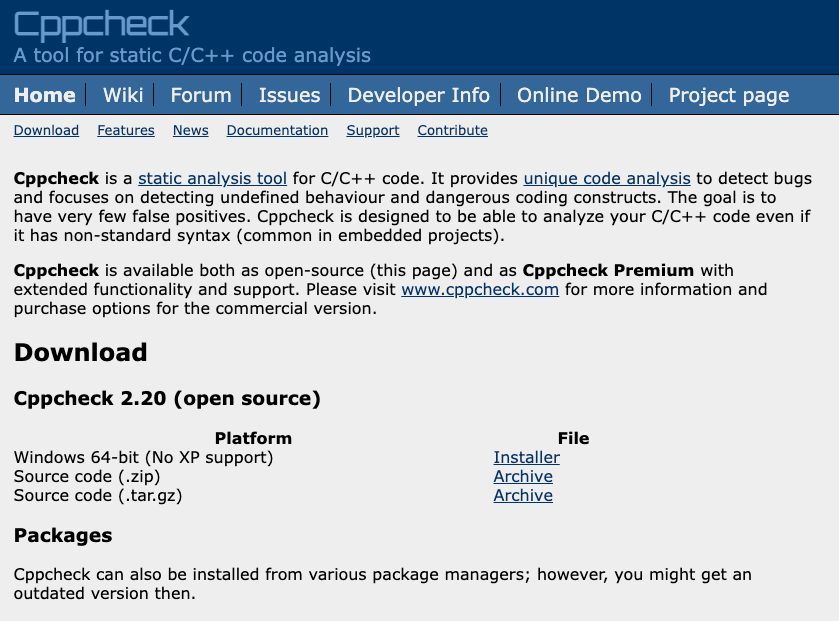
Cppcheck is a favorite for teams looking for a fast, no-frills analyzer. It focuses on detecting undefined behavior and runtime-error risks while keeping false positives extremely low.
Key features
- Very lightweight and easy to automate
- Works on virtually any platform
- Great starting point for open-source or small teams
4. Clang Static Analyzer
The Clang Static Analyzer is built into the LLVM toolchain and benefits from deep compiler knowledge. It excels in finding issues like null dereferences, double frees, and unreachable paths.
Key features
- Tight integration with Clang and LLVM
- Highly accurate path-sensitive analysis
- Works natively within many modern build systems
5. Parasoft C/C++test

Parasoft C/C++test is a comprehensive solution for regulated industries, combining static analysis, unit testing, and coverage tooling tailored to compliance workflows.
Key features
- Strong support for strict coding standards
- Enterprise dashboards and workflow automation
- Integrates with testing and verification pipelines
Choosing the Right Tool for Your C Project
Selecting the right static analysis tool for a C project starts with understanding your priorities: security, reliability, compliance, maintainability, or development speed. Teams building safety-critical or regulated systems—such as automotive, aerospace, or medical devices—often need analyzers that support strict standards like MISRA C, CERT-C, or AUTOSAR. In these environments, comprehensive tools such as SonarQube, Parasoft, or PC-Lint/FlexeLint can enforce coding rules consistently and help produce audit-ready reports. For teams focused on security-first development, especially where memory safety is a concern, platforms like SonarQube, Coverity, or PVS-Studio excel at uncovering complex vulnerabilities and providing actionable remediation guidance.
For smaller teams, open-source projects, or rapid prototyping, lightweight tools like Cppcheck, Clang Static Analyzer, or Semgrep may be sufficient and easy to automate. Organizations with sprawling or long-lived codebases may also benefit from tools like CppDepend, which help visualize architecture and track technical debt over time. In many cases, the best strategy is a hybrid approach: using a primary platform like SonarQube for continuous, end-to-end code quality and security monitoring, supplemented by specialized analyzers where needed. Ultimately, the right tool is the one that integrates seamlessly into your workflow, minimizes noise, and provides developers with clear, actionable insights that keep your C codebase healthy for the long term.
FAQs
1. What types of issues can C static code analysis detect?
C static code analysis can uncover a wide range of issues before the code ever runs, including memory safety problems (buffer overflows, use-after-free, null-pointer dereferences), undefined behavior, data races, insecure API usage, coding standard violations, and maintainability concerns such as duplicated logic or overly complex functions. Modern tools also map findings to security standards like CWE and CERT-C.
2. Is static analysis enough to guarantee bug-free C code?
No—static analysis is a powerful tool, but it doesn't replace testing, code review, fuzzing, or runtime analysis. Instead, it complements them by catching classes of issues that are difficult or impossible to detect through dynamic testing alone. The strongest C development teams combine static analysis with robust testing, continuous integration, and defensive coding practices.
3. How often should teams run static analysis on C code?
In 2026, best practice is to run static analysis continuously: during development in the IDE, on every pull request, and as part of CI/CD pipelines. Platforms like SonarQube or SonarQube Cloud make continuous analysis automatic, ensuring issues are detected early—when they’re cheapest to fix.
4. Do static analysis tools support compliance with standards like MISRA C or CERT-C?
Yes. Many static analysis tools offer built-in rule sets for industry standards such as MISRA C, CERT-C, AUTOSAR, and other safety or security guidelines. Tools like SonarQube, Parasoft, and PC-Lint/FlexeLint can enforce these rules automatically, helping teams meet certification requirements and produce audit-ready reports.
5. Can static analysis handle large or legacy C codebases?
Absolutely. Modern static analyzers are designed to scale to millions of lines of code and integrate with complex, multi-decade build systems. Tools like SonarQube, Coverity, and PVS-Studio are particularly well suited for large or older codebases, offering accurate results with minimal noise and clear guidance for gradually reducing accumulated technical debt.
