Best Code Verification Tools for Developers in 2026

TL;DR overview
- Code verification is the essential software engineering process of ensuring code correctly implements expected requirements and behaves according to its specified design ("building the product right").
- It combines static verification (like static analysis and anti-pattern detection) and dynamic verification (such as unit, integration, and stress tests) to eliminate bugs and security vulnerabilities.
- Top tools like SonarQube, PVS-Studio, Qodana, Parasoft, and ESLint help automate continuous code quality inspections and enforce strict security compliance gates within CI/CD pipelines.
- Implementing a layered, multi-tool pipeline allows modern engineering teams to catch defects early, control technical debt, and manage complex cross-repository or cloud-native architectures.
Why Code Verification is Important in 2026
In 2026, software verification is no longer just a quality checkpoint — it’s a foundational discipline in modern software engineering. As applications grow more distributed, cloud-native, and AI-assisted, ensuring correctness, reliability, and alignment with expected requirements has become significantly more complex. Teams must verify code across multiple programming languages, microservices, APIs, and third-party dependencies while maintaining high standards of software quality, application security, and cloud computing security. Effective verification — including both static verification (such as static analysis, code conventions verification, anti-pattern detection, and software metrics calculation) and dynamic verification (such as experimentation, runtime verification, unit tests, integration tests, system tests, acceptance tests, stress tests, and other functional and non-functional tests) — ensures defects are identified early in the software development lifecycle. This reduces software bugs, limits regressions, and prevents security vulnerabilities from reaching production environments.
At the same time, rising regulatory pressure, increased cyber threats, and the widespread adoption of AI-generated code have made rigorous verification and validation practices essential. Organizations must distinguish between software validation (building the right product) and verification (building the product right), using techniques such as formal verification, static testing, dynamic testing, and even elements derived from the theory of computation to mathematically prove aspects of system behavior in high-assurance environments. Integrated with code review, automated vulnerability scanners, and continuous inspection pipelines, verification activities help control technical debt, improve maintainability through code refactoring and code cleanup, and support long-term compliance. In short, in 2026, code verification is critical not just for functionality, but for delivering secure, resilient, and trustworthy software at scale.
What is Code Verification?
Code verification, often referred to within the broader discipline of software verification, is the process of ensuring that software correctly implements its expected requirements and behaves according to its specified design. In software engineering, verification answers the question: “Are we building the product right?” It focuses on evaluating source code and related artifacts to confirm correctness, consistency, and compliance with functional and non-functional requirements. Verification activities span both static verification — such as static analysis, static testing, code conventions verification, anti-pattern detection, software metrics calculation, and formal verification — and dynamic verification, which includes dynamic testing, experimentation, runtime verification, and structured test approaches like unit tests (test in the small), module tests, integration tests, system tests, acceptance tests, functional tests, non-functional tests, and stress tests. Together, these techniques help detect software bugs, logic errors, security vulnerabilities, and performance issues before release.
Code verification is closely related to, but distinct from, software validation. While validation ensures the right product is being built, verification ensures it is built correctly according to specifications. Modern verification integrates automated code review, vulnerability scanners, and continuous inspection tools into CI/CD pipelines to maintain high software quality, reduce technical debt, and support ongoing application security and cloud computing security requirements. In high-assurance or safety-critical systems, teams may even apply elements of formal verification grounded in the theory of computation to mathematically prove properties of a program written in a given programming language. In 2026, code verification is not a single step, but a continuous, automated discipline embedded across the entire software development lifecycle.
The Top Code Verification Tools for 2026
Effective software verification ensures your software meets expected requirements, functions correctly, and remains secure against defects and vulnerabilities. From static verification to dynamic verification, unit and integration testing support, and AI-assisted review, these tools help improve code correctness, reduce technical debt, and enforce quality at scale.
1. SonarQube

G2 Review: 4.4/5
SonarQube is a comprehensive platform for continuous static analysis and software quality inspection. It analyzes source code to detect bugs, vulnerabilities, code smells, and standard violations across multiple programming languages, helping teams measure correctness and enforce quality gates during CI/CD.
Key Features
- Deep static verification and code quality metrics
- Security hotspot and vulnerability detection
- Quality gates for pull request validation
- Dashboard with actionable insights on bugs and technical debt
- Integrations with IDEs, GitHub, GitLab, and CI/CD tools
Best for: Teams needing broad language support and continuous software verification with integrated security analysis.
2. PVS-Studio
G2 Review: 5/5
PVS-Studio is a powerful static analysis tool that identifies subtle bugs, anti-patterns, undefined behaviors, and security issues in C, C++, C#, and Java code. It’s excellent for detecting correctness issues that slip past standard compilers and for mitigating vulnerabilities early in the SDLC.
Key Features
- Deep pattern-based static code analysis
- Support for common security standards (CERT, MISRA, CWE)
- Integrates with common IDEs and build systems
- High-precision diagnostics with guided fixes
- Detailed reporting with filtering and suppression options
Best for: Large enterprise and safety-critical codebases requiring rigorous static verification and vulnerability detection.
3. Qodana
G2 Review: 4.5/5
Qodana, developed by JetBrains, enables static analysis and verification across modern tech stacks. It helps enforce coding conventions, prevent regressions, and automate quality checks directly in CI pipelines, combining style enforcement with actionable insights.
Key Features
- Language-agnostic analysis via plugins and engines
- CI/CD pipeline integration for automated verification
- Quality profiles and custom rule sets
- Support for code style, performance, and correctness checks
- Visual reports for developer feedback and trend tracking
Best for: Teams looking for flexible static verification that integrates tightly with development workflows and IDEs.
4. Parasoft C/C++test

G2 Review: 4.7/5
Parasoft C/C++test combines static code analysis, dynamic testing, code coverage, and automated unit testing generation into one suite. It matches verification activities to expected requirements and helps validate runtime behavior as well as structural correctness.
Key Features
- Static analysis and compliance checks
- Dynamic verification via runtime error detection
- Automated unit test generation
- Code coverage and traceability to requirements
- Built-in reporting for quality and compliance
Best for: Teams building safety-critical systems where both static and dynamic verification are essential.
5. ESLint
G2 Review: N/A
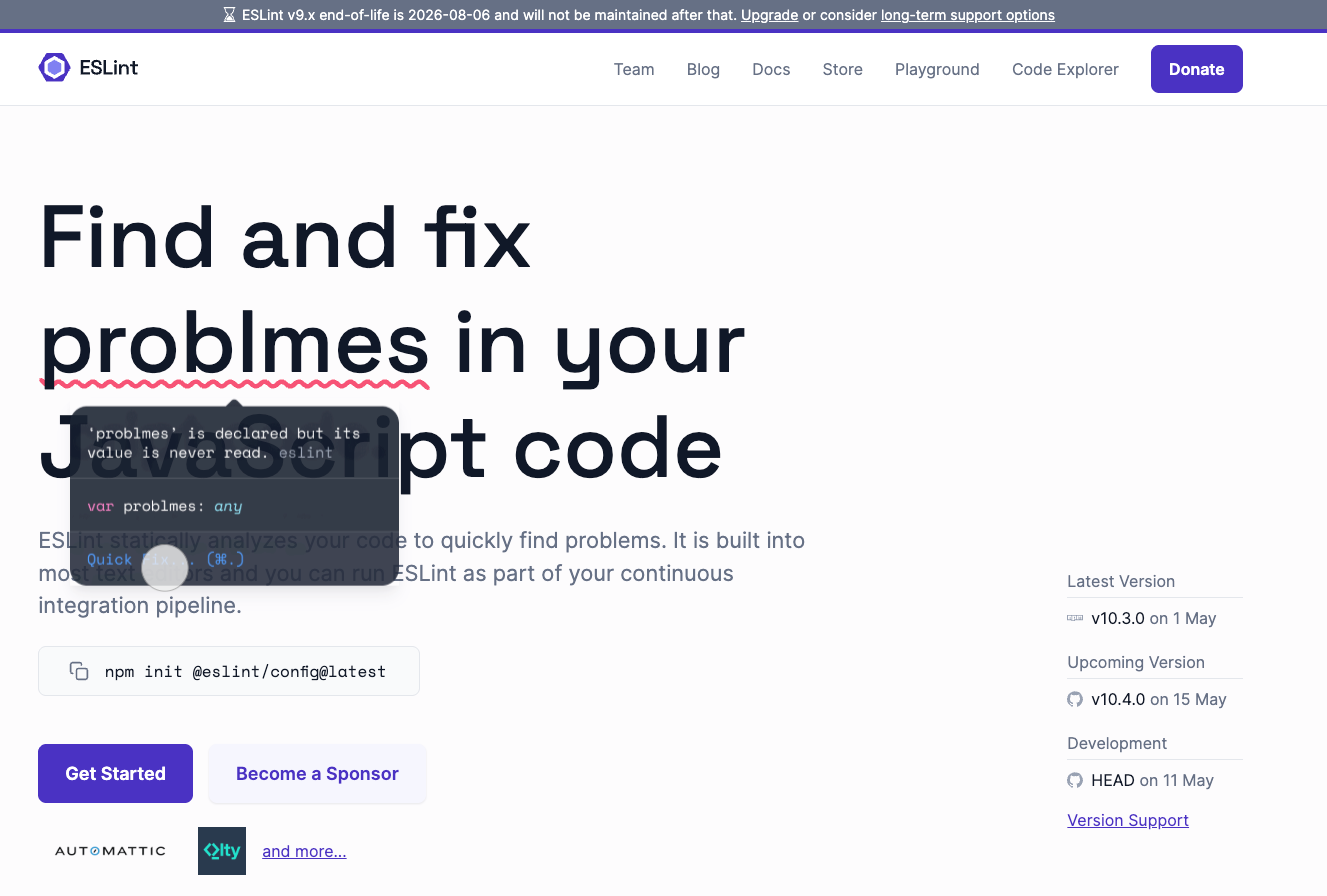
ESLint is a widely adopted linter for JavaScript and TypeScript that enforces style conventions, detects syntax errors, and prevents common bugs before code executes. It’s a core part of static verification for web applications and integrates with most editors and build tools.
Key Features
- Real-time linting and pattern enforcement
- Pluggable rules and configuration profiles
- Supports TypeScript through plugins
- Integration with editors and CI pipelines
- Auto-fix capabilities for many rule violations
Best for: Web developers and full-stack teams prioritizing static verification and code consistency in JS/TS projects.
Choosing the Right Verification Stack
Selecting verification tools depends on several factors:
Team size and budget
- Small teams benefit from integrated solutions like SonarCloud or GitHub Advanced Security
- Enterprises often need the governance features of SonarQube or Checkmarx
Language diversity
- Polyglot codebases require multi-language tools like SonarQube or Semgrep
- Single-language teams can leverage specialized tools for deeper analysis
Compliance requirements
- Regulated industries may need specific certifications
- Security-focused tools like Snyk provide compliance reporting
Development workflow
- Pre-commit hooks benefit from fast tools like Semgrep
- CI/CD integration requires tools with good API support. SonarQube and SonarCloud provide native CI/CD integrations and APIs for automated gating.
Building an Effective Verification Pipeline
The most effective approach combines multiple tools at different stages:
- IDE integration — Catch issues as developers write code
- Pre-commit hooks — Block obvious problems before commits
- Pull request checks — Comprehensive analysis before merge
- Scheduled scans — Deep security analysis on main branches
- Production monitoring — Runtime verification for deployed code
This layered approach ensures that issues are caught at the earliest possible stage while providing comprehensive coverage.
Future Trends in Code Verification
Several emerging trends will shape code verification tools in the coming years:
- Specification inference — AI systems that automatically generate formal specifications from code behavior
- Cross-repository analysis — Tools that understand dependencies and interactions across microservices
- Natural language requirements verification — Checking code against plain-English specifications
- Continuous formal verification — Making mathematical proofs practical for everyday development
FAQs
1. What is the difference between code verification and code validation?
Code verification ensures that software correctly implements its specified requirements — in other words, “Are we building the product right?” It focuses on correctness, static analysis, dynamic testing, and formal verification techniques to detect defects. Software validation, on the other hand, answers “Are we building the right product?” by confirming the solution meets user needs and business goals. In practice, modern development teams combine verification and validation within CI/CD pipelines to maintain high software quality and application security.
2. What are the main types of code verification?
There are two primary categories: static verification and dynamic verification. Static verification analyzes source code without executing it and includes static testing, anti-pattern detection, code conventions verification, software metrics calculation, and vulnerability scanning. Dynamic verification evaluates software during execution through experimentation and structured testing such as unit tests (test in the small), integration tests, system tests, acceptance tests, functional tests, non-functional tests, and stress tests. Combining both approaches provides stronger defect detection and correctness guarantees.
3. Why is static analysis important for developers?
Static analysis plays a critical role in early defect detection. It helps identify software bugs, security vulnerabilities, coding standard violations, and maintainability issues before code reaches production. By integrating static verification tools into pull requests and CI pipelines, teams reduce technical debt, improve code review efficiency, and strengthen cloud computing security and application security posture without waiting for runtime failures.
4. How does dynamic verification improve software reliability?
Dynamic verification validates how software behaves under real execution conditions. It uncovers runtime errors, memory issues, integration failures, and performance bottlenecks that static analysis may miss. Through unit, module, integration, and system testing — along with runtime verification and stress testing — teams gain confidence that their applications meet both functional and non-functional requirements. This improves resilience and overall software quality in production environments.
5. Do developers need both static and dynamic verification tools in 2026?
Yes. In 2026, modern software engineering requires layered verification strategies. Static verification ensures structural correctness and security at the source code level, while dynamic verification confirms behavior under execution. Together — supported by automated code review, vulnerability scanners, and even formal verification techniques grounded in the theory of computation — they help teams deliver secure, scalable, and reliable software across multiple programming languages and cloud-native architectures.
