Best Java Static Code Analysis Tools for Developers in 2026

TL;DR overview
- Java Static Code Analysis evaluates Java source or bytecode without execution to detect critical bugs, technical debt, style deviations, and security vulnerabilities (SAST).
- Modern Java code quality tools act as active DevSecOps pipeline partners, offering real-time IDE feedback and AI-driven remediation suggestions.
- Leading security-focused and customizable platforms include SonarQube, Snyk Code, Checkmarx, and Semgrep, alongside traditional open-source tools like PMD and SpotBugs.
- Selecting the right tool depends on organization priorities, ranging from comprehensive central dashboards to rapid developer-centric security feedback in CI/CD pipelines.
Why Static Code Analysis is Important in 2026
Java remains the backbone of enterprise applications, driving performance and scalability across industries. However, as development speeds accelerate—driven by AI assistants and rapid CI/CD cycles—the risk of introducing subtle bugs, code smells, and, most critically, security vulnerabilities (SAST) has never been higher.
In 2026, the best Java Static Code Analysis tools are no longer passive checkers; they are active partners in the DevSecOps pipeline. They must integrate seamlessly into the IDE, offer AI-powered remediation suggestions, and provide immediate, context-aware feedback.
This guide breaks down the leading tools that define modern Java code quality, focusing on enterprise-scale, security-first, and developer-centric solutions.
What is Java Static Code Analysis?
Static Code Analysis is a method of examining source code without executing it (hence, "static") to find potential errors, security flaws, bugs, and deviations from coding standards.
For Java, this means analyzing .java files, .class files (bytecode), and configuration files to ensure:
- Code Quality: Detecting issues like dead code, overly complex methods, or potential null pointer dereferences.
- Security (SAST): Finding critical vulnerabilities like SQL injection, cross-site scripting (XSS), or insecure deserialization.
Maintainability & Style: Enforcing team-wide formatting rules, naming conventions, and minimizing technical debt.
The Top 5 Java Static Code Analysis Tools for 2026
The market for Java static code analysis tools has converged, with the most successful platforms combining traditional code quality features with advanced security capabilities (SAST) and AI-driven automation.
1. SonarQube

SonarQube is a comprehensive platform for static code analysis and continuous code quality assessment. It supports Java (and many other languages) and is used to detect bugs, code smells, vulnerabilities, and maintain metrics on code health. It’s more than a simple rule-checker — it provides dashboards, historical tracking, quality gates, and integration into CI/CD workflows. In particular for Java, the vendor states they “create dedicated static analysis rules so you learn shiny, new features and avoid pitfalls.”
Key Features:
- Large rule set for Java (and other languages) — e.g., for Java it offers 650+ static code analysis rules according to their site.
- Detection of bugs, vulnerabilities & code smells (i.e., structural issues, maintainability problems) across source code.
- Quality gates / enforceable thresholds (you can set criteria like “no new critical issues” before merge) and integration with CI builds.
- Historical tracking and dashboards (so you can see trends over time: technical debt, duplicates, complexity) and visualization of code health.
- Multi-language and broad ecosystem (especially helpful if you have Java + other languages) and good integration with build and version control tools.
- Customizable rulesets and extension capability (for example you can tailor rules for your team) and IDE integration via plugins.
2. Snyk Code
Snyk has carved out a niche as the security tool built for the modern developer workflow. It is ideal for DevSecOps teams prioritizing rapid vulnerability detection and open-source security. Snyk differentiates itself by focusing on speed, accuracy, and remediation, particularly in cloud-native environments.
Key Features:
- Contextual Fix Suggestions that deliver AI-driven, pre-validated fixes, ready to apply with a single click directly in the Pull Request.
- Unified SAST & SCA, analyzing both code security issues and open-source dependency vulnerabilities in one platform.
- Optimized for speed, offering real-time, incremental security results directly inside the IDE.
- Security-focused, which may result in fewer broad code-quality rules compared to a platform like SonarQube.
3. Checkmarx

Checkmarx is a mature, enterprise-grade Application Security Testing (AST) suite. It's often chosen by large organizations in regulated industries (finance, healthcare) due to its comprehensive language support, advanced taint analysis, and robust governance features.
Key Features:
- Built for highly regulated environments, delivering deep, compliant security analysis across large and complex codebases.
- Advanced Data Flow Analysis that expertly traces tainted data across components, making it especially strong for complex Java microservices.
- Unmatched accuracy and compliance reporting, with robust support for standards like OWASP Top 10 and PCI DSS.
- Powerful but demanding, with a steeper learning curve and time-consuming initial deep scans.
4. Semgrep
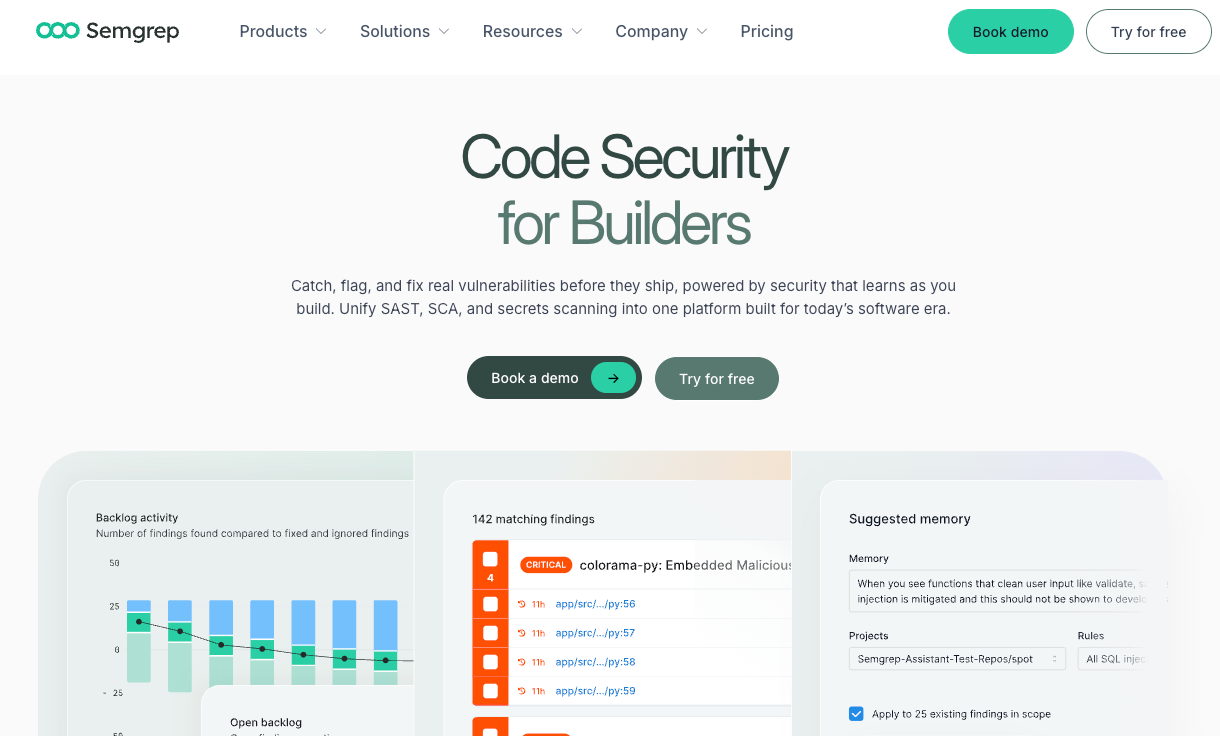
Semgrep is the favorite tool for security engineers and developers who need speed and customization. It uses a lightweight pattern matching syntax that allows teams to write new rules specific to their codebase or proprietary frameworks in minutes, making it highly adaptable to unique Java environments.
Key Features:
- Highly flexible, custom rule creation, ideal for teams that need rapid, precise policy enforcement during Pull Requests.
- Simple Rule Syntax, allowing complex analysis rules to be written as code patterns in lightweight YAML for fast customization.
- Blazing-fast performance, running effectively on every commit or even pre-commit hooks.
- Open-source core with optional SaaS enhancements, though teams must invest time in writing or curating custom rules to realize full value.
5. PMD & SpotBugs
For decades, PMD (Programming Mistake Detector) and SpotBugs (the spiritual successor to FindBugs) have been the foundation of Java static analysis. These open-source tools are still indispensable, especially for developers and small teams looking for fast, effective analysis that integrates directly with build tools like Maven and Gradle.
- PMD focuses on Code Style, Complexity, Dead Code, and common errors, using its customizable rule sets.
- SpotBugs focuses on Bug Patterns, such as potential null pointer dereferences, infinite loops, resource leaks, and concurrency issues within the bytecode.
They are free and open source, lightweight, and fast, making them essential tools for bootstrapping projects. However, their rule sets primarily target bugs and style; they are not a replacement for modern, dedicated SAST tools like Snyk or Checkmarx that focus on deep security flaws.
Choosing the Right Tool for Your Java Project
The "best" tool for your team in 2026 depends heavily on your priorities:
- If your primary goal is comprehensive code quality, technical debt reduction, and a central dashboard, SonarQube remains the strongest choice.
- If your priority is to "shift security left" and empower developers with fast, accurate security feedback (SAST and SCA) in their workflow, Snyk Code is the market leader.
- For small teams and open-source projects needing fundamental style enforcement and bug detection without budget, a combination of PMD and SpotBugs is essential.
Regardless of your choice, integrating static analysis into your CI/CD pipeline and ensuring real-time feedback in your IDE are the two non-negotiable standards for modern Java development in 2026.
FAQs (Frequently Asked Questions)
1. What is Java Static Code Analysis?
Java Static Code Analysis is the process of examining Java source code without executing it to identify bugs, security vulnerabilities, code smells, and maintainability issues. Tools analyze patterns, syntax, data flow, and best-practice rules to provide actionable insights early in development.
2. Why should I use static analysis for my Java projects?
Static analysis helps teams:
- Detect issues early in the development lifecycle
- Maintain consistent coding standards
- Improve security by catching vulnerabilities before runtime
- Reduce technical debt through continuous feedback
- Increase long-term maintainability and reliability
- It acts as an automated reviewer that never gets tired.
3. How does static analysis differ from dynamic analysis?
- Static analysis inspects code statically (without running it), focusing on structure, syntax, flow, and patterns.
- Dynamic analysis examines code during execution, evaluating runtime behavior like memory usage, performance, and concurrency issues.
Ideally, teams use both to achieve full coverage.
4. Can static analysis find all bugs in Java code?
No. Static analysis is powerful but not exhaustive. It excels at pattern-based and structural issues—such as null dereferences, injection risks, improper API use, or unused code. However, it may miss runtime-specific problems like race conditions, environment-driven behavior, or input-dependent logic. Static analysis should complement, not replace, testing.
5. What should I look for in a Java static analysis tool?
A strong Java static analysis tool typically offers:
- High rule accuracy with minimal false positives
- Security coverage (e.g., OWASP Top 10)
- Data flow analysis for deep vulnerability detection
- IDE integration for instant feedback
- Pull Request integration with clear, actionable reports
- Custom rule creation for enforcing internal standards
Tools like SonarQube, SonarQube Cloud, SonarQube for IDE, Semgrep, Checkmarx, and others provide varying strengths depending on security depth, code quality needs, and customization.
