Best Ruby Static Code Analysis Tools for Developers in 2026

TL;DR overview
- Ruby static code analysis examines Ruby source code without executing it to detect bugs, security vulnerabilities, code smells, and coding standard violations early in the software development lifecycle.
- Implementing static application security testing (SAST) and automated code review helps developers identify injection flaws, cross-site scripting (XSS), and complex technical debt in dynamically typed Ruby on Rails environments.
- Continuous inspection using a vulnerability scanner integrates securely into CI/CD pipelines and repositories like GitHub, enforcing consistent secure coding standards before production runtime.
- Advanced code quality platforms like SonarQube provide comprehensive governance, technical debt measurement, and maintainability scoring across diverse Ruby implementations like MRI, JRuby, and TruffleRuby.
Why Ruby Static Code Analysis Is Important in 2026
Ruby remains a powerful, general-purpose programming language built around object-oriented programming, where everything is an object and behavior is driven through message passing, classes, methods, blocks, and iterators. Its dynamic typing, duck typing, metaprogramming, and reflective capabilities—features inspired by languages like Smalltalk, Lisp, Python, Perl, Ada, Eiffel, and C++—make it highly expressive and productive. However, these same characteristics can introduce hidden risks in large-scale systems. In complex Ruby on Rails applications running across distributed and cloud-native environments, issues tied to dynamic scope, lexical scope, unsafe input handling, or poorly structured control structures can silently accumulate as technical debt. Without strong static analysis, vulnerabilities such as injection flaws, broken access control, and cross-site scripting can slip into production, impacting application security, reliability, and overall software quality.
In 2026, as organizations increasingly deploy Ruby services across cloud infrastructures and CI/CD pipelines, static application security testing (SAST) and automated code review have become foundational to secure software development. Modern vulnerability scanners and static code analysis platforms help detect bugs, security vulnerabilities, code smells, duplication, and excessive complexity before runtime—reducing remediation costs and strengthening secure coding practices. Static analysis also supports continuous inspection, maintainability scoring, and measurable quality gates, enabling teams to control risk while preserving Ruby’s development speed and expressiveness. For teams relying on Ruby implementations like MRI, YARV, JRuby, TruffleRuby, Rubinius, mruby, and RubyMotion, proactive static analysis is no longer optional—it is essential for sustaining scalable, secure, and high-quality software systems.
What is Ruby Static Code Analysis?
Ruby static code analysis is the process of examining Ruby source code—such as .rb and .ru files—without executing the program, in order to detect bugs, security vulnerabilities, code smells, complexity issues, and violations of coding standards. Because Ruby is a high-level, interpreted, multi-paradigm programming language that supports object-oriented programming, functional programming, imperative programming, and powerful metaprogramming, its flexibility can introduce subtle risks. Static analysis tools inspect classes, methods, instance variables, accessor patterns (attr_reader, attr_writer), blocks, iterators, control structures, and message passing patterns to identify weaknesses early in the software development lifecycle. This is particularly important in Ruby’s dynamically typed and duck-typed environment, where runtime behavior can differ significantly from what is inferred during development.
In modern Ruby on Rails applications and other Ruby frameworks, static code analysis is commonly used as part of static application security testing (SAST) and automated code review workflows. Advanced analyzers function as a vulnerability scanner, detecting injection flaws, cross-site scripting (XSS), insecure deserialization, and other OWASP-related risks that impact application security and cloud computing security. Beyond security, these tools measure maintainability, duplication, and complexity to help teams reduce technical debt, improve software quality, and enforce secure coding standards across repositories managed with tools like GitHub and distributed through RubyGems. Whether running on MRI (Matz’s Ruby Interpreter), YARV, JRuby, TruffleRuby, or other implementations, static analysis provides a scalable way to ensure Ruby codebases remain reliable, maintainable, and secure in 2026.
The Top 5 Ruby Static Code Analysis Tools for 2026
Ruby remains one of the most expressive and developer-friendly general-purpose programming languages, known for its object-oriented programming, dynamic typing, duck typing, garbage collection, and strong focus on developer happiness. Designed by Yukihiro Matsumoto (Matz) and first released in 1995, Ruby is a multi-paradigm, interpreted, high-level language that supports functional programming, imperative programming, metaprogramming, and reflective capabilities.
From Ruby on Rails web applications to cross-platform services running on implementations like MRI, YARV, JRuby, TruffleRuby, Rubinius, mruby, and RubyMotion, maintaining high standards of software quality, secure coding, and application security is essential.
That’s where static code analysis comes in.
Static analysis tools analyze Ruby source code (e.g., .rb, .ru) without executing it. They help detect:
- Bugs and reliability issues
- Security vulnerabilities (e.g., injection, XSS)
- Code smells and maintainability problems
- Violations of coding standards
- Complexity and duplication
- Sources of technical debt
Below are the best Ruby static code analysis tools for developers in 2026, with SonarQube ranked #1 for comprehensive code quality and security.
1. SonarQube

Best for: End-to-end code quality and security governance across teams and enterprises
SonarQube leads the Ruby ecosystem in 2026 by delivering advanced static application security testing (SAST), vulnerability detection, and deep code quality analysis in a single platform.
It supports Ruby projects across modern development environments, integrates with CI/CD pipelines, and enhances both centralized dashboards and developer workflows through SonarQube for IDE and SonarQube Cloud.
Why SonarQube is #1 for Ruby
SonarQube goes beyond simple linting. It provides:
- Detection of bugs, security vulnerabilities, and code smells
- Identification of OWASP Top 10 risks (e.g., injection, broken access control)
- Advanced static analysis for Ruby and Ruby on Rails
- Security hotspots with contextual remediation guidance
- Technical debt measurement
- Maintainability, reliability, and security ratings
- Clean, structured dashboards for governance
- Integration into GitHub, GitLab, Azure DevOps pull request workflows
- Continuous inspection across the SDLC
Key Capabilities for Ruby
- Analysis of object-oriented design, classes, methods, instance variables, and message passing patterns
- Detection of unsafe dynamic behavior common in dynamically typed languages
- Review of metaprogramming risks
- Cloud and cloud computing security support for distributed architectures
- Support for secure coding best practices
For teams working with Ruby’s flexible syntax, blocks, iterators, lexical scope, and dynamic features, SonarQube provides the most complete safety net for long-term maintainability and security.
2. RuboCop
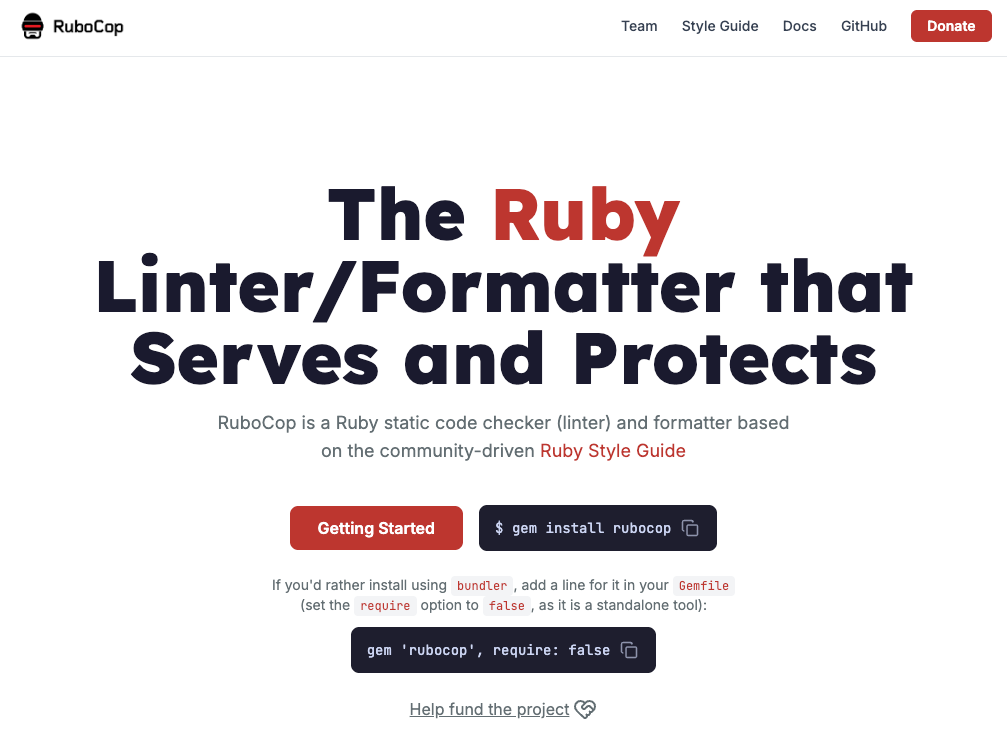
Best for: Enforcing style, syntax consistency, and maintainability
RuboCop is the de facto Ruby linter and formatter built around the Ruby Style Guide. It enforces consistency in:
- Classes and methods
- Blocks and iterators
- Control structures
- Scope semantics
- Accessor methods (
attr_reader,attr_writer) - Expression usage
It’s ideal for keeping Ruby codebases readable and standardized across teams.
Key Features
- Hundreds of configurable “cops”
- Autocorrection support
- Rails-specific extensions
- CI/CD integration
- RubyGems ecosystem support
While RuboCop improves structure and consistency, it does not provide deep application security or enterprise-level vulnerability scanning.
3. Brakeman
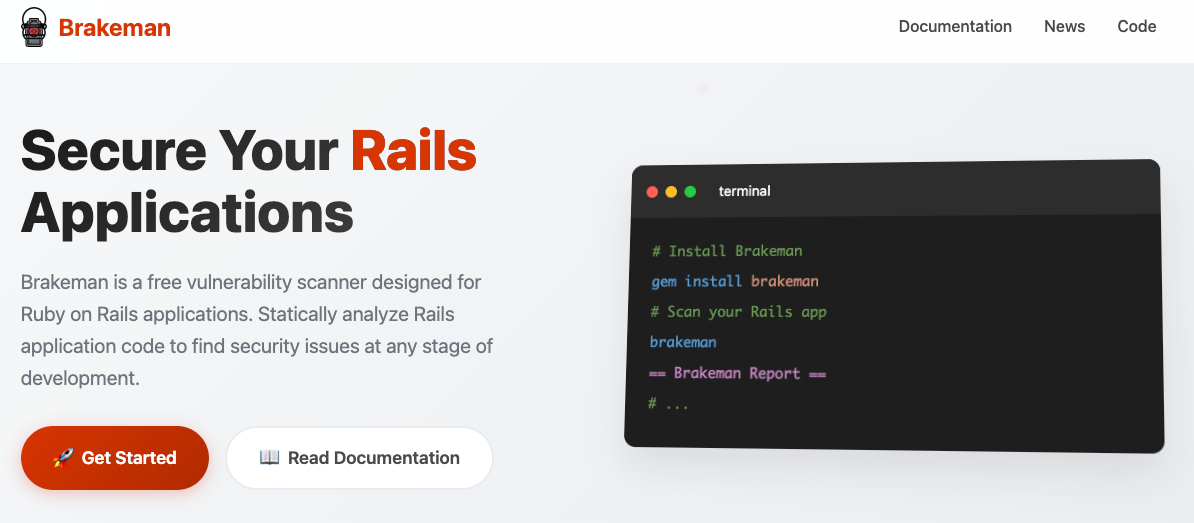
Best for: Static security analysis of Rails applications
Brakeman is a specialized security vulnerability scanner focused on Ruby on Rails.
It detects:
- SQL injection
- Cross-site scripting (XSS)
- Mass assignment vulnerabilities
- Unsafe parameter usage
It analyzes Rails application structure without executing code, making it suitable for DevSecOps pipelines.
Brakeman is strong for Rails-specific SAST but lacks the broader maintainability and technical debt insights provided by SonarQube.
4. Reek
Best for: Identifying design issues and refactoring candidates
Reek focuses on detecting code smells that increase technical debt, such as:
- Long methods
- Feature envy
- Duplicate logic
- High complexity
It’s valuable for teams practicing code refactoring, especially in object-oriented Ruby systems where everything is an object and design clarity is critical.
5. RubyCritic
Best for: Aggregated code metrics and maintainability reports
RubyCritic combines multiple static analysis tools to produce visual reports showing:
- Code complexity
- Duplication
- Smell density
- Maintainability trends
It’s useful for development teams tracking quality metrics over time.
Choosing the Right Tool for Your Ruby Project
Choosing the right Ruby static code analysis tool depends on your architecture, risk profile, and long-term software quality goals. Ruby is a multi-paradigm, object-oriented, dynamically typed programming language that supports meta programming, functional programming, and expressive constructs like blocks, iterators, and message passing. Whether you’re building a monolithic Ruby on Rails application, a microservice running on MRI (Matz’s Ruby Interpreter) or YARV, or a cross-platform system powered by JRuby, TruffleRuby, Rubinius, or mruby, your tooling must account for complexity, maintainability, and application security. Teams focused primarily on style consistency and syntax enforcement may prioritize linting tools, while organizations concerned with scalability, compliance, and cloud computing security should adopt platforms that deliver deep static application security testing (SAST), integrated code review, and enterprise-grade vulnerability scanner capabilities.
In 2026, the most effective strategy is often layered. Use lightweight linters to enforce conventions around classes, methods, accessor patterns, and control structures, while relying on a centralized platform like SonarQube for comprehensive code quality and security governance. Advanced platforms help detect bugs, injection flaws, cross-site scripting (XSS), insecure dependencies distributed through RubyGems, duplication, and excessive complexity—while also measuring technical debt, maintainability, and reliability. Look for tools that integrate seamlessly with CI/CD pipelines, Git-based workflows, and IDE environments such as SonarQube for IDE, enabling continuous inspection throughout the SDLC. Ultimately, the right solution should not only analyze Ruby syntax but also strengthen secure coding practices, improve design quality in object-oriented systems, and support sustainable, high-quality software delivery.
FAQs
1. What is the best Ruby static code analysis tool in 2026?
In 2026, SonarQube is widely considered the most comprehensive Ruby static code analysis solution. It provides advanced static application security testing (SAST), detects security vulnerabilities, bugs, and code smells, and measures technical debt and maintainability. Unlike basic linters, SonarQube delivers centralized dashboards, CI/CD integration, and continuous inspection across Ruby and Ruby on Rails projects, making it ideal for teams prioritizing both code quality and security.
2. Why is static code analysis important for Ruby applications?
Ruby is a dynamic, object-oriented programming language with features like duck typing, metaprogramming, and reflective capabilities. While these features increase developer productivity, they can also introduce hidden runtime risks. Static code analysis helps detect vulnerabilities such as injection flaws and cross-site scripting (XSS), as well as bugs and design issues, before deployment—improving application security, reducing technical debt, and strengthening overall software quality.
3. Does Ruby on Rails require specialized static analysis tools?
Yes. While general Ruby linters improve syntax and maintainability, Ruby on Rails applications benefit from specialized security-focused tools. Rails introduces framework-specific risks such as mass assignment and parameter handling issues. Tools with strong vulnerability scanners and SAST capabilities can identify Rails-specific security weaknesses and help enforce secure coding practices across controllers, models, and views.
4. What types of issues can Ruby static analysis tools detect?
Ruby static analysis tools can detect:
- Security vulnerabilities (e.g., injection, XSS, unsafe deserialization)
- Code smells and duplication
- Excessive complexity
- Violations of coding standards
- Bugs and reliability issues
- Maintainability risks
- Accumulating technical debt
Advanced platforms also assess cloud computing security risks and integrate with automated code review workflows to enforce quality gates.
5. Can Ruby static code analysis be integrated into CI/CD pipelines?
Yes. Modern Ruby static analysis tools integrate seamlessly into CI/CD pipelines and Git-based workflows. They automatically analyze pull requests, enforce quality gates, and provide feedback in developer environments like SonarQube for IDE. This enables continuous inspection throughout the software development lifecycle, helping teams maintain secure, scalable Ruby applications across implementations such as MRI, JRuby, and TruffleRuby.
