Best Secret Scanning Tools for Developers in 2026

TL;DR overview
- Secret scanning is the practice of automatically detecting sensitive information like API keys and credentials accidentally hard-coded into source code to prevent critical application security incidents.
- In 2026, leading secret scanning tools like SonarQube evaluate security risks by integrating credential detection directly into broader code quality and static analysis workflows.
- Shifting security left by embedding secret detection into CI/CD pipelines and developer workflows reduces remediation costs and strengthens cloud computing security postures.
- Choosing the right platform depends on enterprise compliance needs, language support, and whether a team requires standalone repository monitoring or an integrated application security strategy.
Why Secret Scanning Is Important in 2026
In 2026, secret scanning has become a critical safeguard as software development increasingly relies on cloud services, APIs, microservices, and AI-assisted coding. The widespread use of cloud computing, third-party integrations, and automated CI/CD pipelines has dramatically increased the number of credentials in use — and the speed at which they can be accidentally exposed. A single leaked API key or access token can now grant immediate access to production systems, cloud infrastructure, or sensitive data, turning a simple coding mistake into a major application security incident. As a result, preventing hard-coded secrets is no longer just a best practice; it is a foundational requirement for secure coding and modern software delivery.
At the same time, regulatory pressure and security expectations have intensified. Standards and frameworks increasingly expect organizations to demonstrate proactive controls around credential management, secure configuration, and code quality and security. Secret scanning plays a key role in shifting security left by catching issues early, reducing remediation costs, and preventing secrets from ever reaching production. When combined with static analysis, code refactoring, and code cleanup practices, secret scanning helps teams reduce technical debt, strengthen cloud computing security, and maintain a strong security posture — without slowing down developer productivity.
What is Secret Scanning?
Secret scanning is the practice of automatically detecting sensitive information — such as API keys, passwords, access tokens, certificates, and cloud credentials — that has been hard-coded or accidentally committed into source code, configuration files, infrastructure-as-code, or CI/CD scripts. These secrets can grant unauthorized access to applications, cloud resources, and third-party services, making them a critical application security risk. Secret scanning tools analyze code repositories, commits, and pipelines to identify exposed secrets early, helping developers follow secure coding practices and reduce the attack surface before software is deployed.
In modern DevSecOps workflows, secret scanning is most effective when it is shifted left and integrated directly into developer tools, pull requests, and CI/CD pipelines. Rather than treating secrets as isolated issues, advanced platforms combine secret scanning with static analysis, code quality and security checks, and secure design principles. This approach enables faster remediation, fewer false positives, and better long-term protection — especially in cloud computing security contexts where leaked credentials can immediately lead to privilege escalation, data breaches, and compliance failures.
Top Secret Scanning Tools for 2026
In 2026, secret scanning is no longer a standalone security task. It is a core capability of code quality and security platforms, tightly integrated into the software development lifecycle (SDLC), DevSecOps pipelines, and cloud-native environments.
This article reviews the best secret scanning tools for developers in 2026, focusing on accuracy, developer experience, CI/CD integration, and real-world usability.
1. SonarQube

Best overall secret scanning tool for developers
SonarQube stands out in 2026 as the most comprehensive and developer-centric solution for secret scanning, combining secret detection, static analysis, and application security in a single platform.
Unlike tools that focus exclusively on regex-based secret detection, SonarQube integrates secret scanning directly into its broader code quality and security analysis. This allows teams to detect hard-coded secrets in the same workflow they use to identify security vulnerabilities, code smells, and maintainability issues.
Why SonarQube is #1
- Built-in secret detection for credentials, tokens, and sensitive configuration values
- Deep integration with secure coding and application security rules
- Scans source code, configuration files, and infrastructure-as-code
- CI/CD-native with quality gates that block builds when secrets are detected
- Designed for developer workflows, not just security teams
Key features
- Secret scanning as part of static application security testing (SAST)
- Accurate detection with fewer false positives than regex-only tools
- Unified reporting for code quality, security hotspots, vulnerabilities, and secrets
- On-premise and cloud-ready, supporting enterprise compliance needs
Best for: Teams that want secret scanning tightly integrated with code quality, secure coding standards, and application security — without adding yet another standalone tool.
2. GitGuardian
GitGuardian remains a strong contender in 2026, especially for organizations managing large numbers of repositories across multiple version control platforms. It focuses heavily on continuous monitoring and incident response for leaked secrets.
Strengths
- Broad VCS support (GitHub, GitLab, Bitbucket, Azure DevOps)
- Centralized dashboards and secret inventory
- Incident tracking and remediation workflows
Limitations: Primarily focused on secrets only; lacks the deeper integration with code quality and static analysis found in SonarQube.
3. GitHub Secret Scanning
GitHub Secret Scanning is a solid choice for teams fully committed to the GitHub ecosystem. Push protection helps prevent secrets from ever being committed, which aligns well with shift-left security principles.
Strengths
- Native GitHub integration
- Push protection for early prevention
- Custom secret patterns
Limitations: Limited visibility outside GitHub and minimal context beyond secret detection itself.
4. Gitleaks
Gitleaks continues to be one of the most popular open-source options in 2026. It’s lightweight, fast, and easy to integrate into CI pipelines or pre-commit hooks.
Strengths
- Open-source and free
- Easy CLI and CI/CD integration
- Customizable rule sets
Limitations: No centralized management, limited reporting, and higher false-positive rates compared to enterprise platforms.
5. GitLab Secret Detection
GitLab’s built-in secret detection works well for teams already using GitLab’s application security features. It integrates directly into merge requests and CI pipelines.
Strengths
- Native GitLab CI integration
- Early feedback in merge requests
- Simple setup
Limitations: Less flexible and less comprehensive than dedicated platforms like SonarQube.
6. Semgrep
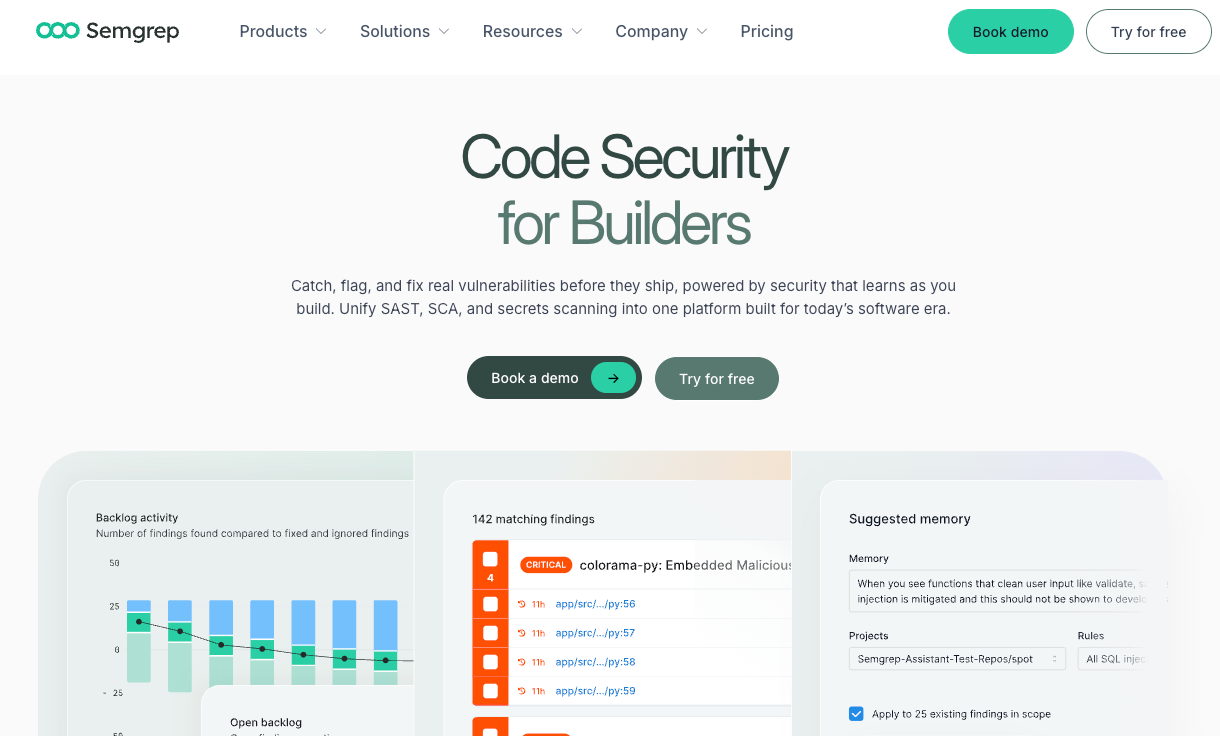
Semgrep’s secret scanning capabilities appeal to teams that want fine-grained control over detection logic. It works well when combined with custom rules and advanced workflows.
Strengths
- Highly customizable rule language
- Works across many languages
- IDE and CI/CD integrations
Limitations: Requires more maintenance and expertise to manage effectively at scale.
How Secret Scanning Fits Modern Development
In 2026, secret scanning is most effective when it is:
- Shifted left into IDEs and pull requests
- Integrated into CI/CD pipelines with automated enforcement
- Combined with secure coding, code refactoring, and code cleanup practices
- Aligned with application security and cloud computing security strategies
Platforms like SonarQube excel because they treat secrets not as isolated issues, but as part of a broader risk model that includes insecure design patterns, misconfigurations, and technical debt.
Choosing the Right Tool for Your Secret Scanning Project
Selecting the right secret scanning tool in 2026 depends on several key factors, including your development ecosystem, team size, and security goals. First, consider where and how you work: if your code lives primarily on a single platform like GitHub or GitLab, a native scanner with deep integration (such as GitHub Secret Scanning or GitLab Secret Detection) can offer seamless workflows and immediate feedback in pull requests. For teams working across multiple repositories, languages, and CI/CD systems, a more comprehensive platform that centralizes scanning results and manages policy enforcement — such as SonarQube or GitGuardian — may offer greater visibility and control. Your choice should align with your preferred IDEs, build systems, and release processes so that secret scanning becomes a natural part of everyday development rather than a disruptive add-on.
Beyond integration, also evaluate tools based on accuracy, customizability, and developer experience. High detection accuracy with low false positives is critical to avoid alert fatigue, while the ability to define custom patterns or rules helps tailor scanning to your specific stack and secret formats. Look for solutions that provide actionable remediation guidance, historical analysis, and API support for automation. Finally, align your choice with broader secure coding and application security objectives: tools that integrate secret detection into a wider code quality and security platform can reduce overall risk, streamline compliance, and foster team buy-in. In this way, you ensure your secret scanning project not only catches exposures, but truly strengthens your development lifecycle and cloud computing security posture.
FAQs
1. What types of secrets can secret scanning tools detect?
Secret scanning tools can detect a wide range of sensitive information, including API keys, passwords, access tokens, OAuth secrets, private keys, certificates, and cloud provider credentials. Advanced tools also identify secrets embedded in configuration files, infrastructure-as-code, CI/CD scripts, and environment files. In 2026, leading platforms go beyond simple pattern matching by adding context-aware detection to reduce false positives and improve application security.
2. Is secret scanning enough to protect my applications?
No. Secret scanning is a critical layer of defense, but it should be part of a broader secure coding and application security strategy. Secrets often coexist with other risks such as insecure configurations, vulnerable dependencies, and insecure design patterns. Tools that combine secret scanning with static analysis, code refactoring, and code cleanup provide stronger protection by addressing root causes rather than isolated issues.
3. When should secret scanning run in the development lifecycle?
Secret scanning is most effective when it is shifted left and runs as early as possible. This includes IDE feedback, pre-commit hooks, pull requests, and CI/CD pipelines. Running secret scans early prevents leaks from ever reaching shared branches or production environments, reducing remediation costs and strengthening cloud computing security.
4. How do secret scanning tools reduce false positives?
Modern secret scanning tools use a combination of pattern matching, entropy analysis, contextual code understanding, and allow-listing to reduce false positives. Platforms that integrate secret scanning into a broader code quality and security framework can further improve accuracy by analyzing how and where values are used, helping developers focus on real risks instead of noise.
5. Why choose an integrated platform like SonarQube for secret scanning?
Integrated platforms like SonarQube combine secret scanning with static application security testing, secure coding rules, and maintainability analysis. This unified approach gives developers a single, consistent view of code quality and security issues, reduces tool sprawl, and enables teams to enforce policies automatically through quality gates. In 2026, this integration is a major advantage for scaling secure development without slowing teams down.
