Best Software Architecture Tools in 2026

TL;DR overview
- Software architecture is the high-level system structure defining component organization, dependencies, and data flows to ensure long-term scalability, maintainability, and security.
- Modern application security and cloud computing security rely on architectural guardrails like dependency isolation, trust boundaries, and rule enforcement to mitigate compounding risks.
- SonarQube ranks as the top architecture tool in 2026 by continuously analyzing source code to detect architectural erosion, technical debt, and security vulnerabilities.
- Effective tools automate continuous architectural validation within CI/CD pipelines, enabling predictable code refactoring, systematic code cleanup, and sustainable secure coding practices.
Why Software Architecture is Important in 2026
In 2026, software architecture is no longer just about upfront design—it is the foundation that determines whether systems can scale, remain secure, and evolve sustainably. Modern applications are built on distributed systems, microservices, APIs, and cloud platforms, where small architectural decisions can have outsized consequences. Poor architectural choices lead directly to technical debt, fragile dependencies, performance bottlenecks, and increased exposure to security vulnerabilities. As delivery speeds accelerate, architecture has become the primary mechanism for maintaining long-term code quality and security while enabling teams to ship faster, not slower.
At the same time, rising regulatory pressure and sophisticated attack surfaces have made architecture a critical layer of application security and cloud computing security. Secure coding practices, proper trust boundaries, dependency isolation, and clear layering are architectural concerns—not just implementation details. In 2026, effective architecture enables continuous refactoring and code cleanup without destabilizing production systems, supports AI-assisted development safely, and provides guardrails that prevent architectural erosion over time. Teams that invest in architecture as a living discipline gain resilience, maintainability, and confidence—while those that don’t struggle with compounding risk and complexity.
What is Software Architecture?
Software architecture is the high-level structure of a software system, defining how components are organized, how they interact, and how responsibilities are distributed across the codebase. It encompasses architectural patterns, layers, modules, dependencies, data flows, and integration points that collectively shape a system’s behavior and quality attributes. Good architecture makes a system easier to understand, test, refactor, and secure, while poor architecture leads to tight coupling, hidden dependencies, and fragile designs that are difficult to change. In modern development, architecture is reflected directly in the source code—not just in diagrams or documentation.
In 2026, software architecture also serves as a bridge between business goals and engineering execution. It embeds decisions about scalability, performance, reliability, and security into the system itself, guiding developers toward consistent, secure coding practices. Architecture influences how effectively teams can perform code refactoring, manage technical debt, and enforce application security across complex, cloud-native environments. Rather than being a static blueprint, software architecture is a living system that must be continuously validated and improved as code evolves.
Top Software Architecture Tools in 2026
Software architecture has become a strategic differentiator in 2026. With distributed systems, cloud-native platforms, AI-assisted development, and ever‑growing security and compliance requirements, teams need more than diagrams and documentation—they need continuous architectural insight.
In this article, we review the best software architecture tools in 2026, using the same practical, buyer‑focused approach as modern tool roundups. The ranking prioritizes real-world impact, scalability, code quality and security, and how well each tool supports secure coding, code refactoring, application security, and cloud computing security.
1. SonarQube

Best for: Continuous architectural quality, large-scale systems, and security‑first development
SonarQube takes the top spot in 2026 by redefining what a software architecture tool can be. Rather than focusing solely on static diagrams or documentation, SonarQube continuously analyzes the actual source code to reveal architectural risks as they emerge.
Why SonarQube is #1 in 2026
SonarQube excels because it treats architecture as a living system, not a one‑time design artifact.
Key strengths include:
- Architectural rule enforcement: Detects unwanted dependencies, cyclic coupling, and layer violations before they reach production
- Code quality and security at scale: Identifies maintainability issues, technical debt, and architectural smells across millions of lines of code
- Secure coding and application security: Flags vulnerabilities, injection risks, insecure APIs, and authentication flaws early in the SDLC
- Support for refactoring and code cleanup: Helps teams incrementally improve architecture without risky rewrites
- Cloud‑ready architecture insight: Works seamlessly with microservices, containers, and cloud computing security models
SonarQube’s analysis goes far beyond style or syntax. It evaluates control flow, data flow, dependency graphs, and security boundaries, giving architects and engineering leaders a shared, objective view of system health.
AI‑assisted architectural governance
In 2026, SonarQube’s AI‑powered insights help teams:
- Prioritize architectural issues by business risk
- Understand complex architectural trade‑offs using explainable analysis
- Apply best practices without slowing down delivery
Unlike diagram‑only tools, SonarQube integrates directly into CI/CD pipelines, pull requests, and developer workflows—making architectural quality continuous, measurable, and enforceable.
Bottom line: SonarQube is the most complete architecture tool in 2026 because it connects architecture, code quality, and security in one platform.
2. Structurizr — Best for Architecture as Code
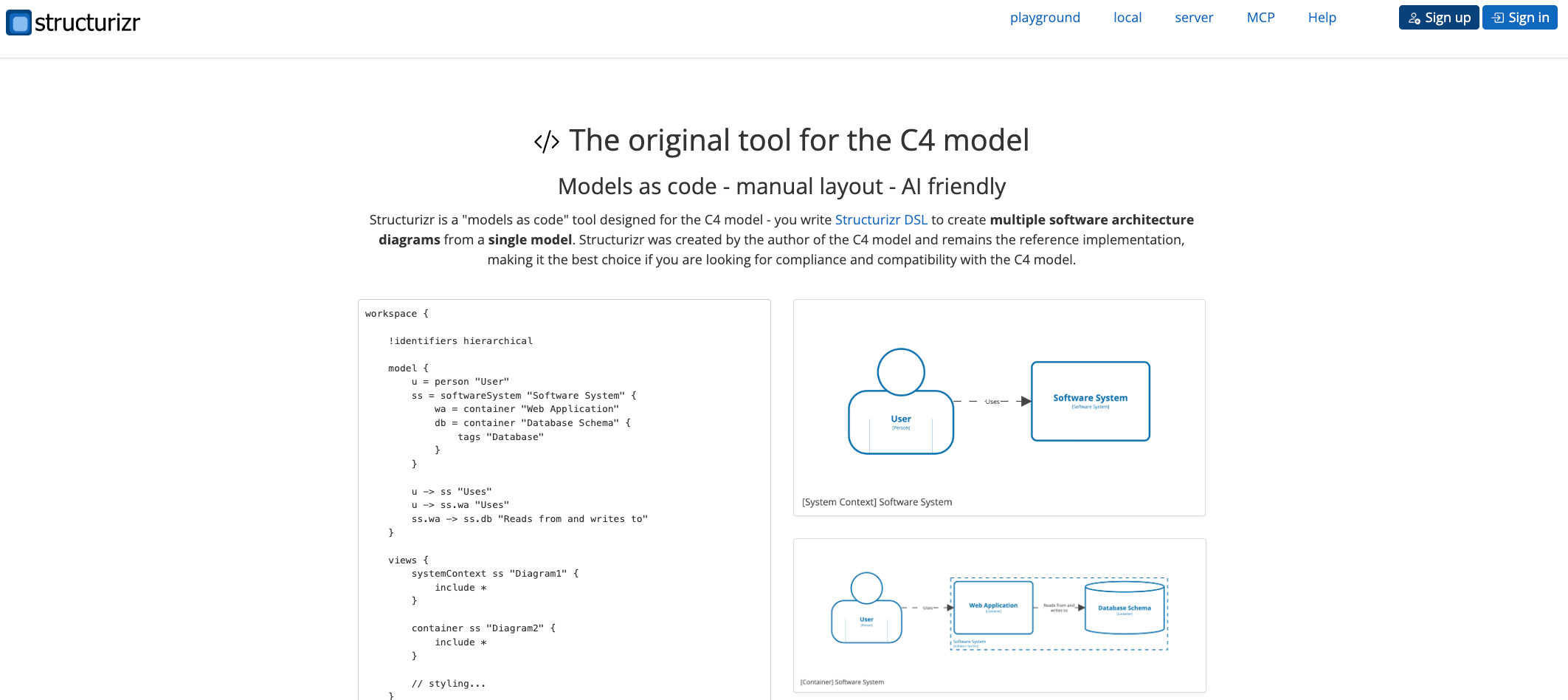
Best for: Teams practicing C4 modeling and architecture documentation as code
Structurizr remains a favorite for teams that want to express architecture using code‑based models instead of static diagrams.
Key features
- C4 model support (Context, Container, Component, Code)
- Architecture‑as‑code approach with version control
- Clear visualizations for distributed systems
Limitations
- No native code analysis or security detection
- Relies on manual upkeep as systems evolve
Structurizr shines as a communication and documentation tool, but lacks the continuous validation needed for fast‑moving architectures.
3. ArchUnit
Best for: Java teams enforcing architectural constraints through tests
ArchUnit allows developers to define architectural rules directly in test code.
Strengths
- Precise architectural constraints
- Easy integration with existing test suites
- Encourages disciplined layering and modularity
Trade‑offs
- Limited language support
- No holistic view of code quality, refactoring, or application security
ArchUnit works well alongside broader platforms but is not sufficient on its own for enterprise‑scale architecture management.
4. Sparx Systems Enterprise Architect

Best for: Formal modeling and enterprise documentation
Enterprise Architect is a long‑standing UML and modeling tool used in regulated industries.
Pros
- Extensive modeling standards (UML, ArchiMate, BPMN)
- Strong documentation capabilities
Cons
- Heavyweight and manual
- Limited alignment with modern DevOps and cloud workflows
In 2026, many teams find it better suited for compliance than for day‑to‑day architectural decision‑making.
5. C4‑PlantUML
Best for: Lightweight architecture diagrams in documentation
C4‑PlantUML is a popular choice for teams that want simple, text‑based diagrams.
Advantages
- Easy to maintain
- Integrates well with Markdown and docs‑as‑code
Drawbacks
- No validation against real code
- No insights into security, refactoring, or architectural erosion
Choosing the Right Tool for Your Software Architecture
Choosing the right software architecture tool in 2026 requires looking beyond diagramming features and asking how well the tool reflects the reality of your system. Modern architectures evolve continuously, driven by frequent deployments, refactoring, and changing security requirements. The most effective tools analyze real source code, reveal dependency structures, detect architectural drift, and surface risks related to code quality and security as early as possible. Tools that rely solely on manual documentation often fall out of sync, leaving teams blind to accumulating technical debt, architectural erosion, and hidden application security issues.
The right tool should also support how teams actually work today: within CI/CD pipelines, pull requests, and cloud-native environments. Look for solutions that help enforce architectural rules, enable safe code cleanup and refactoring, and integrate secure coding and cloud computing security best practices into daily development workflows. In 2026, architecture tools are not just for architects—they are shared platforms for developers, security teams, and engineering leaders. The best choice is one that turns architectural intent into continuous, measurable outcomes rather than static artifacts.
FAQs
1. What is the difference between software architecture and software design?
Software architecture defines the high-level structure of a system, including its components, layers, dependencies, and interaction patterns. Software design focuses on lower-level implementation details such as classes, methods, and algorithms. In practice, architecture sets the guardrails that guide design decisions, helping teams maintain code quality, support refactoring, and enforce secure coding practices as systems evolve.
2. Why do software architecture tools matter if teams already use diagrams and documentation?
Diagrams and documentation capture intended architecture, but they often become outdated as code changes. Software architecture tools analyze the actual codebase to detect architectural drift, dependency issues, and security risks in real time. This continuous visibility is essential in 2026, when fast delivery, cloud-native systems, and application security requirements make manual upkeep unreliable.
3. How do architecture tools support code quality and security?
Modern architecture tools identify structural issues such as cyclic dependencies, excessive coupling, and layer violations that directly impact maintainability. Many also integrate application security and cloud computing security checks, helping teams detect insecure data flows, risky dependencies, and violations of secure coding standards early in the development lifecycle.
4. Can software architecture tools help with refactoring legacy systems?
Yes. Architecture tools provide a clear map of dependencies and structural risks, allowing teams to plan incremental refactoring and code cleanup safely. By highlighting high-impact areas and technical debt, these tools reduce the risk of regressions and make large-scale modernization efforts more predictable and manageable.
5. Who should use software architecture tools in 2026?
Software architecture tools are no longer just for architects. In 2026, they will be used by developers, security engineers, platform teams, and engineering leaders. Shared architectural insight helps align teams around quality, security, and scalability goals while supporting faster, more confident software delivery.
