Best Taint Analysis Tools for Developers in 2026

TL;DR overview
- Taint analysis is a static code and data-flow analysis technique used in application security to identify vulnerabilities by tracking how untrusted user input propagates to sensitive sinks.
- Top platforms in 2026 like SonarQube, Semgrep Pro, CodeQL, Snyk Code, and Fortify integrate directly into modern DevSecOps pipelines and IDEs.
- The process reduces noise to highlight exploitable paths, directly supporting shift-left security, continuous code refactoring, and automated code cleanup workflows.
- Modern tools are designed to evaluate distributed trust boundaries within complex cloud-native architectures, ensuring robust cloud computing security and compliance.
Why Taint Analysis Is Important in 2026
In 2026, modern software systems are more interconnected, cloud-based, and AI-assisted than ever before, which dramatically increases the number of trust boundaries inside a single application. Data now flows across microservices, APIs, message queues, serverless functions, and third-party integrations, making it easy for untrusted input to reach sensitive operations in unexpected ways. Taint analysis is uniquely suited to this reality because it focuses on how data moves, not just where risky APIs are used—helping teams identify real application security issues such as injection flaws, insecure deserialization, and data leakage early in the development lifecycle.
Just as importantly, taint analysis supports the way developers actually work in 2026. With shift-left security, DevSecOps, and AI-generated code becoming the norm, teams need fast, automated feedback they can trust directly in the IDE and CI pipelines. Effective taint analysis reduces noise, highlights exploitable paths, and provides actionable guidance that encourages secure coding, code refactoring, and code cleanup instead of security theater. The result is not only fewer vulnerabilities in production, but cleaner, more maintainable code that aligns with modern cloud computing security and compliance expectations.
What is Taint Analysis?
Taint analysis is a static code analysis and data-flow analysis technique that tracks how data from untrusted sources (user input, HTTP requests, environment variables, files, network sockets) propagates through a program to sensitive sinks (SQL queries, command execution, file writes, deserialization, authentication logic).
At its core, taint analysis answers questions like:
- Can user input reach a SQL query without sanitization?
- Can data from an API request influence command execution?
- Does sensitive information leak to logs or third-party services?
In 2026, taint analysis is critical because:
- Shift-left security pushes vulnerability detection into the IDE and pull requests
- Cloud-native architectures multiply trust boundaries
- AI-generated code increases the risk of subtle data-flow bugs
- Compliance requirements demand demonstrable secure coding practices
The Top Taint Analysis Tools for 2026
TypeScript has firmly established itself as the backbone of large-scale JavaScript development. In 2026, teams are shipping complex cloud-native applications, microservices, and front-end platforms where code quality and security are no longer optional—they’re foundational to performance, maintainability, and trust.
Static code analysis tools help developers detect bugs, code smells, security vulnerabilities, and maintainability issues early in the software development lifecycle (SDLC). When used correctly, they reinforce secure coding, enable continuous code refactoring and code cleanup, and reduce costly production incidents.
This article reviews the best TypeScript static code analysis tools in 2026, using the same evaluation mindset as our previous language-focused comparisons, and highlighting what makes each tool relevant for modern developers.
1. SonarQube
Best overall taint analysis platform for development teams
SonarQube remains one of the most mature and widely adopted platforms for taint analysis in 2026. Its strength lies in combining precise data-flow analysis with a developer-friendly workflow focused on fixing issues—not just finding them.
Why SonarQube Stands Out
- Advanced interprocedural taint analysis
- Deep understanding of modern frameworks (Spring, .NET, JavaScript, Python, etc.)
- First-class support for application security vulnerabilities (SQL injection, XSS, command injection, deserialization flaws)
- Tight integration with CI/CD pipelines and pull request decoration
- Clear remediation guidance that supports code refactoring and code cleanup
SonarQube’s taint engine is designed to minimize noise while still catching complex, real-world attack paths—making it particularly effective for large teams and enterprise codebases.
Languages: Java, C#, JavaScript/TypeScript, Python, PHP, Go, and more
Best for: Teams that want reliable taint analysis embedded directly into everyday development workflows
2. Semgrep Pro
Best for customizable, rule-driven taint analysis
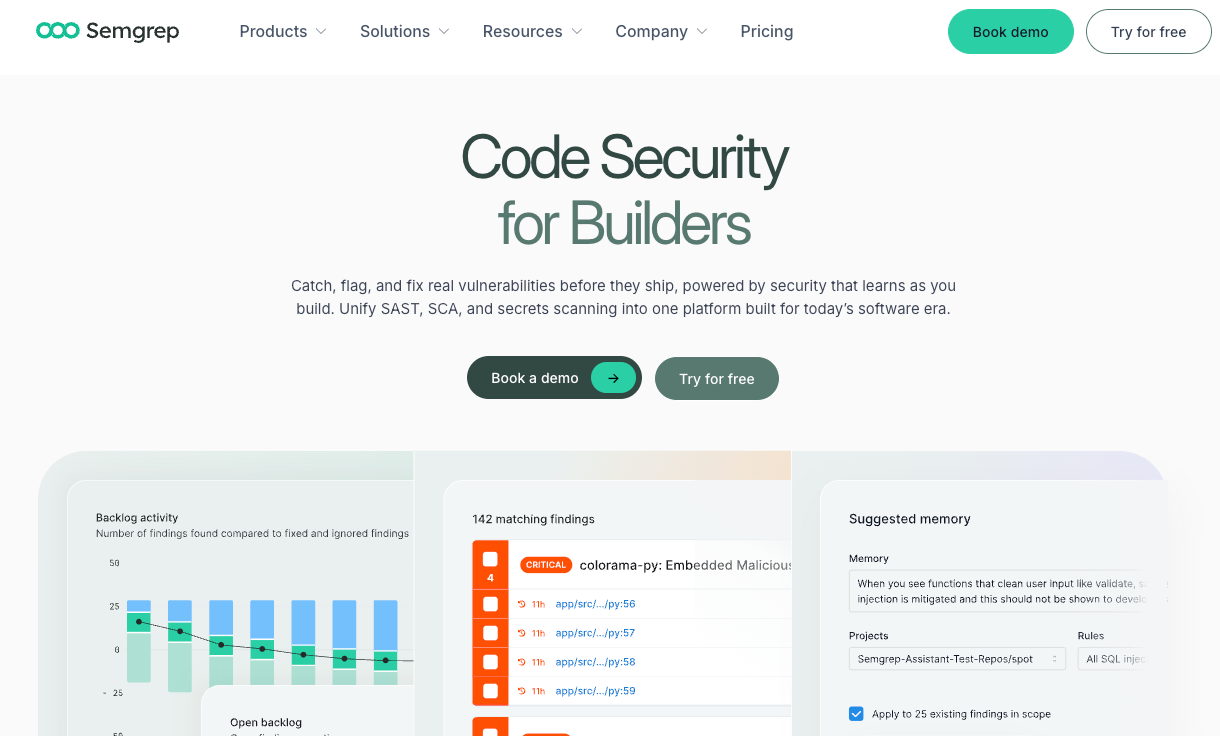
Semgrep’s taint mode allows teams to define custom sources, sinks, and sanitizers, making it a flexible choice for organizations with unique security requirements.
Strengths
- Highly configurable taint rules
- Fast scanning suitable for pre-commit hooks
- Strong support for modern languages and frameworks
- Works well alongside secure coding guidelines
Trade-offs
- Requires expertise to write and maintain effective taint rules
- Higher risk of false positives without careful tuning
Languages: Java, JavaScript, Python, Go, Ruby, and more
Best for: Security-minded teams that want fine-grained control over taint logic
3. CodeQL
Best for deep semantic taint analysis
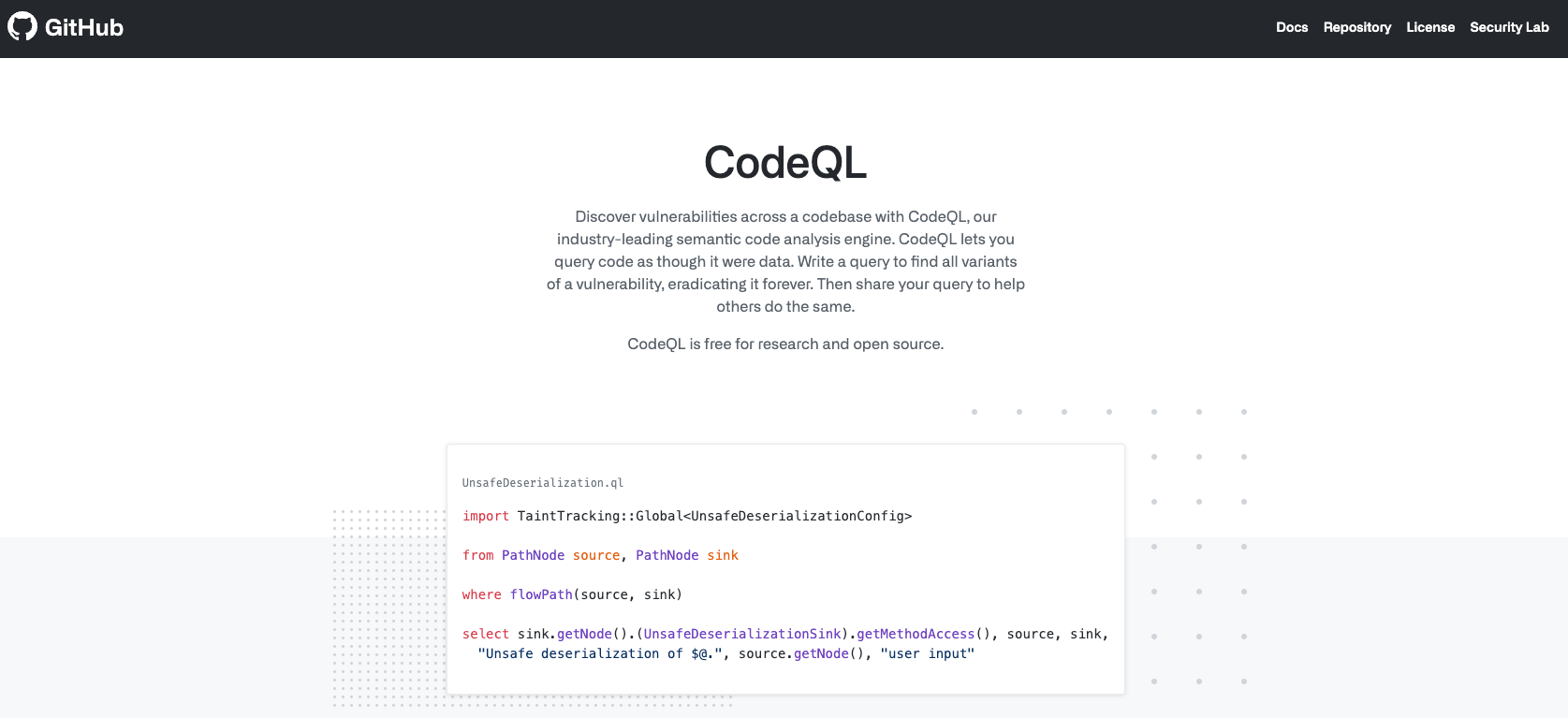
CodeQL treats code as a database, enabling extremely powerful queries over control flow and data flow. Its taint-tracking capabilities are among the most expressive available.
Strengths
- Precise modeling of complex data flows
- Excellent for auditing and vulnerability research
- Strong open-source community rules
Trade-offs
- Steeper learning curve
- Slower feedback compared to IDE-first tools
Languages: C/C++, Java, C#, JavaScript, Python, Go
Best for: Security engineers and teams performing deep vulnerability analysis
4. Snyk Code
Best for developer-friendly security scanning
Snyk Code emphasizes ease of use and fast onboarding. Its taint analysis focuses on identifying exploitable data flows rather than theoretical risks.
Strengths
- Simple setup and clean UI
- Good IDE integrations
- Actionable vulnerability explanations
Trade-offs
- Less configurable than rule-based tools
- Limited visibility into complex data-flow paths
Best for: Developers who want fast, low-friction security feedback
5. Fortify Static Code Analyzer
Best for regulated and compliance-heavy environments
Fortify remains a strong choice for organizations operating under strict regulatory requirements, offering comprehensive taint analysis and reporting.
Strengths
- Mature taint-tracking engine
- Extensive vulnerability taxonomy
- Strong compliance reporting
Trade-offs
- Heavier setup and longer scan times
- Less developer-centric UX
Best for: Large enterprises with formal security governance
Choosing the Right Tool for Your Taint Analysis Project
Choosing the right taint analysis tool in 2026 depends less on finding the “most powerful” engine and more on finding the tool that fits your development reality. Factors like programming languages, frameworks, team size, and deployment model all influence what will be effective in practice. A highly expressive taint engine is useless if developers don’t trust the results or can’t act on them quickly. The best tools integrate naturally into IDEs and CI/CD pipelines, surface real data-flow risks rather than theoretical issues, and provide guidance that aligns with everyday secure coding and application security practices.
It’s also important to consider how taint analysis supports long-term code health. Tools that connect findings to code refactoring and code cleanup help teams reduce technical debt while improving security, instead of treating vulnerabilities as one-off fixes. For cloud-native and compliance-driven environments, scalability, auditability, and support for modern cloud computing security patterns are equally critical. Ultimately, the right tool is the one that developers actually use—one that strengthens security outcomes while reinforcing good engineering habits across the entire lifecycle.
FAQs
1. What types of vulnerabilities does taint analysis help detect?
Taint analysis is especially effective at detecting vulnerabilities where untrusted data flows into sensitive operations. This includes SQL injection, command injection, cross-site scripting (XSS), insecure deserialization, path traversal, and sensitive data leakage. Because it models data flow end to end, it can uncover issues that simple pattern-based scanning often misses.
2. How is taint analysis different from traditional static code analysis?
Traditional static code analysis often focuses on local patterns or rule violations, such as unsafe API usage. Taint analysis goes further by performing interprocedural data-flow analysis, tracking how data moves across functions, files, and layers of an application. This makes it far more effective for real-world application security issues in modern, distributed systems.
3. Does taint analysis work well with cloud-native and microservice architectures?
Yes—modern taint analysis tools are designed to handle cloud-native patterns, including REST APIs, message queues, serverless functions, and service-to-service communication. This is increasingly important in 2026, as cloud computing security depends on understanding how data crosses multiple trust boundaries rather than staying within a single code module.
4. Can taint analysis be used during everyday development, not just security audits?
Absolutely. The most effective tools integrate directly into IDEs and CI pipelines, providing fast feedback during coding and code review. When done well, taint analysis supports secure coding, code refactoring, and code cleanup as part of normal development workflows, rather than being a separate, security-only activity.
5. How can teams reduce false positives when using taint analysis tools?
Reducing false positives depends on choosing a tool with strong semantic understanding and good framework support, as well as tuning it to your codebase. Tools that model sanitization functions, validation logic, and real execution paths tend to produce more actionable results. Developer trust is critical—if findings are consistently relevant, teams are far more likely to fix issues early and systematically.
